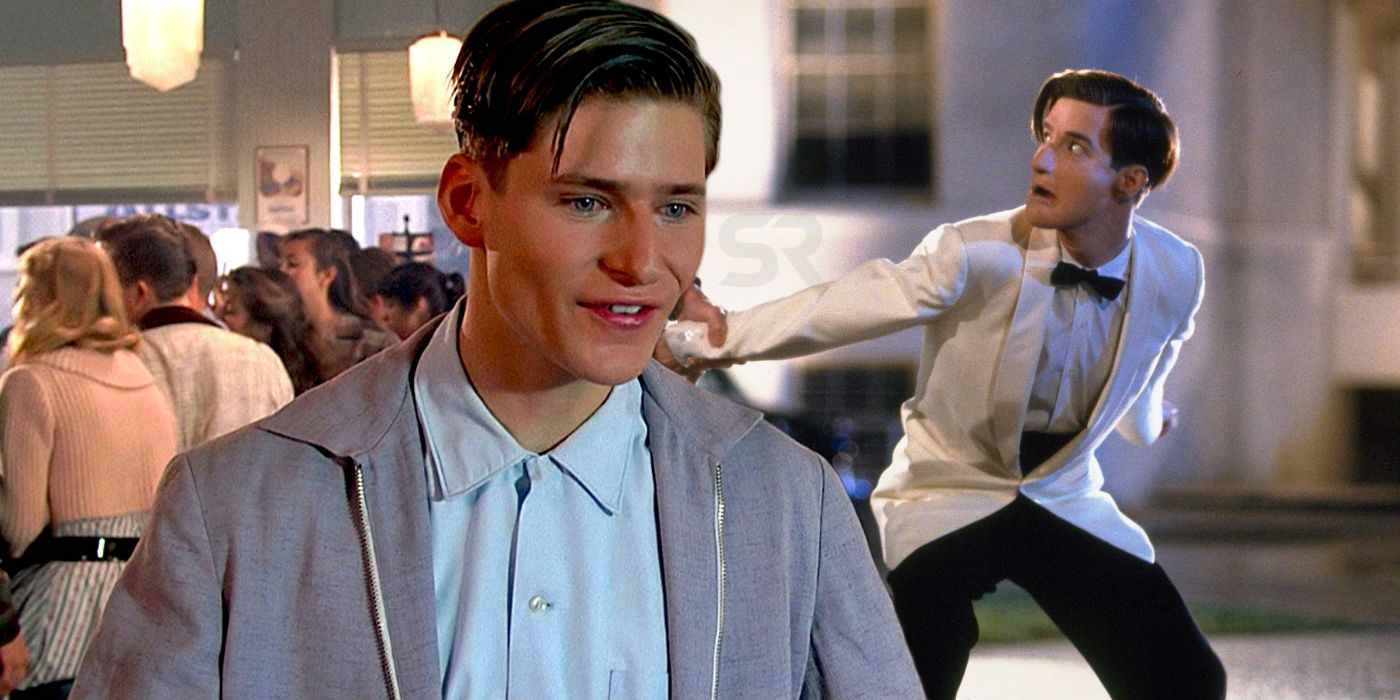
If you grew up watching the Back to the Future trilogy, you probably noticed something felt... off about George McFly in the sequels. In the first film, he’s this quirky, twitchy, strangely charming presence. By the second movie, he’s hanging upside down in an "ortho-lev" or hidden behind massive sunglasses and layers of latex.
Honestly, it wasn’t him.
The story of Crispin Glover in Back to the Future is way weirder than just a simple recasting. It involves a massive ego clash, a philosophical debate about the "Reagan-era" American Dream, and a landmark lawsuit that literally changed how Hollywood works. If you've ever wondered why George McFly basically disappeared into the background, the truth is much pettier—and more fascinating—than you think.
The Fight Over the "Money" Ending
Most actors just say their lines and take the paycheck. Not Crispin. Even during the filming of the 1985 original, he was already butting heads with director Robert Zemeckis.
Glover had a major moral issue with the movie’s ending. You know the one: Marty returns to 1985, and suddenly his family is rich, happy, and successful. His dad is a published author, and Biff is their submissive car-waxing servant. To most of us, it’s a feel-good finale. To Glover? It was "crass materialism."
He actually told Zemeckis that the characters should be in love, but that the wealth shouldn't be the reward. He thought it sent a bad message to the audience—basically that "money equals happiness." Zemeckis and producer Bob Gale weren't exactly thrilled to have a young actor lecturing them on the morality of their script. This friction set the stage for a total breakdown in negotiations when the sequels rolled around.
The Sequel Snub
When it came time to film Back to the Future Part II, the producers approached the original cast. Everyone was game except Glover.
Now, if you ask Bob Gale, he’ll tell you Glover asked for $1 million—the same salary Michael J. Fox was getting. Glover flatly denies this. He claims he was offered $150,000, which was less than half of what Lea Thompson and Thomas F. Wilson were getting for similar-sized roles.
Basically, it was a lowball offer meant to "punish" him for being difficult on the first set. Or maybe they just didn't want him back. Either way, Glover walked away. But instead of just writing the character out or hiring a new actor and letting them be themselves, the studio did something kind of creepy.
They Stole His Face
This is the part that still feels like a sci-fi horror movie. Universal hired an actor named Jeffrey Weissman to play George McFly. But they didn't just want Weissman to play the role; they wanted the audience to think it was still Glover.
They took the facial molds they had of Crispin from the first film (the ones used for his "old man" makeup) and applied them to Weissman’s face. They used prosthetics to mimic Glover’s chin, nose, and cheekbones. They even told Weissman to imitate Glover’s specific, jittery mannerisms.
On set, things got weird. Jeffrey Weissman later recalled that even Steven Spielberg would occasionally address him as "Crispin." Spielberg even joked, "So, Crispin, I see you got your million dollars after all," referring to the rumored salary dispute.
The Lawsuit That Changed Hollywood
Glover eventually saw the movie. He wasn't just annoyed; he was furious. He felt the studio was "stealing" his essence and tricking the audience into believing he had endorsed a project he’d actually rejected.
He sued Universal and Amblin Entertainment for the unauthorized use of his likeness. The studio’s defense was basically: "We own the character of George McFly, so we can make him look however we want."
Glover’s lawyer, Doug Kari, fought back. He argued that while they owned the character, they didn't own Crispin Glover’s actual face. In 1990, the case settled out of court for roughly $760,000.
More importantly, the Screen Actors Guild (SAG) stepped in. Because of the Crispin Glover Back to the Future drama, new rules were written into the SAG collective bargaining agreement. Today, it’s strictly illegal for a studio to use a performer’s likeness—via prosthetics, masks, or even modern AI and CGI—to fool an audience into thinking that actor is in the movie without their consent.
Why It Still Matters Today
Look at the current state of movies. We have digital versions of Peter Cushing in Star Wars, a de-aged Harrison Ford in Indiana Jones, and AI-generated voices everywhere.
None of the legal protections actors have today would exist without Crispin Glover being "difficult" in 1989. He took a huge risk. He could have been blacklisted forever (and for a while, his reputation definitely took a hit). But he stood his ground on a matter of principle.
Key Takeaways for Movie Buffs
- George McFly was played by two people. Jeffrey Weissman is the guy hanging upside down in the second movie, but he’s wearing a "Crispin mask."
- The "Materialism" Debate. Glover’s refusal wasn’t just about money; he genuinely hated the idea that Marty’s "success" was measured by a Toyota truck and a fancy house.
- The Legal Legacy. Every time you see a "re-skinned" actor in a modern blockbuster, there's a contract involved that was shaped by this 30-year-old lawsuit.
If you want to spot the difference, go back and watch Part II again. Pay attention to the scenes in 2015. Notice how George is always upside down, wearing sunglasses, or seen from the back? That was the production team trying desperately to hide the fact that they were using a human puppet to replace a man who refused to sell his face.
Next time you're on a trivia night, you can drop the fact that the most important legal battle in Hollywood history started because George McFly didn't want his family to be "too rich." It’s a classic Hollywood story: messy, petty, and somehow more interesting than the movie itself.