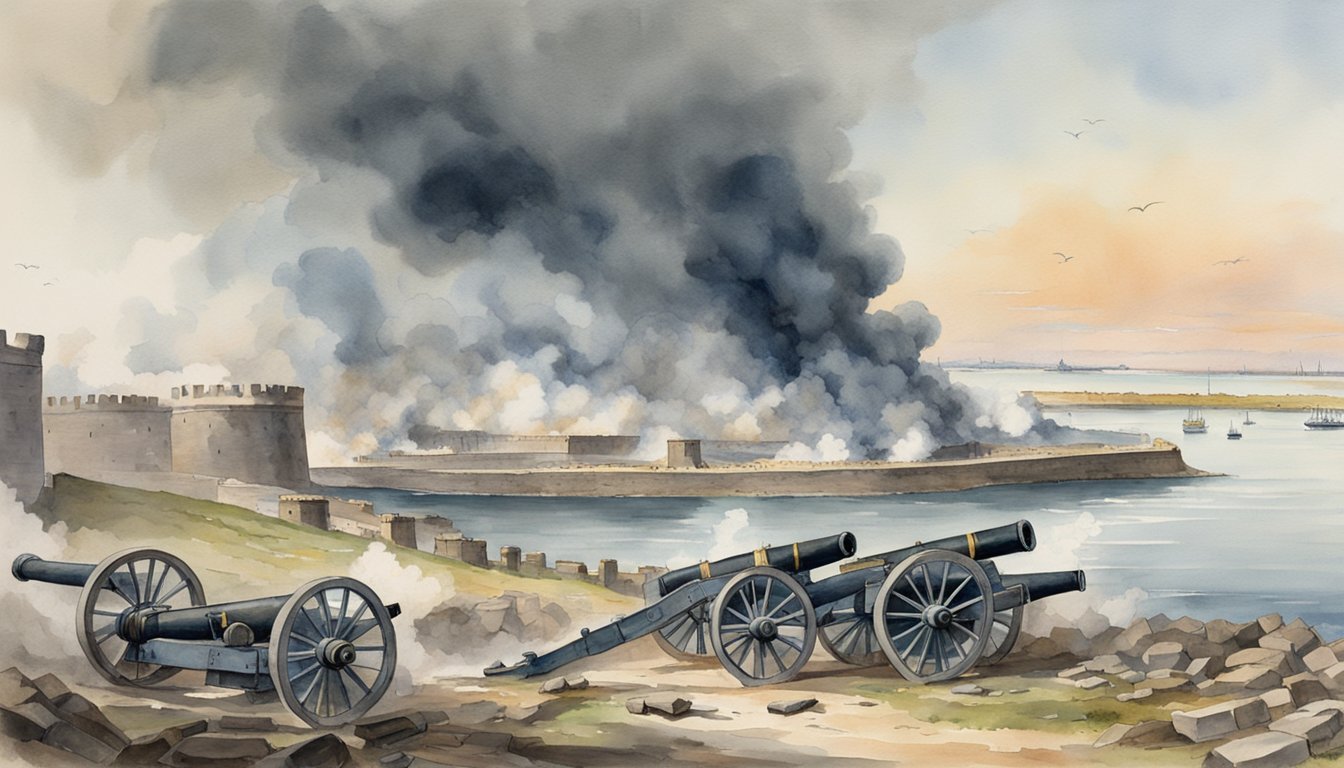
It started with a grocery problem. Honestly, if you strip away the high-minded speeches about state sovereignty and federal overreach, the Battle of Fort Sumter was sparked by a dwindling supply of salt pork and hardtack. Major Robert Anderson was stuck. He was a Kentuckian who had once been a slaveholder, yet he found himself commanding a tiny Union garrison in the middle of a literal volcano of secessionist fervor in Charleston, South Carolina. By April 1861, his men were hungry.
The "battle" wasn't even a battle in the modern sense. Nobody died during the actual bombardment. It's a weird, bloody irony that the deadliest war in American history—600,000-plus souls gone—began with a 34-hour cannonade where the only fatalities were a couple of horses and a stray cat. It wasn't until the surrender ceremony that things got lethal, and even then, it was an accident.
The Fort That Wasn't Even Finished
When you think of a pivotal military installation, you probably imagine a high-tech, impenetrable fortress. Sumter was a mess.
Construction started in 1829, and by 1861, it still wasn't done. It was basically a giant pile of five million bricks sitting on an artificial island. Most of the cannons were pointing the wrong way, or they weren't even mounted yet. Major Anderson had moved his men from Fort Moultrie to Fort Sumter under the cover of darkness on December 26, 1860, because Moultrie was indefensible from the landward side. He thought Sumter would be a safe harbor. He was wrong.
The geography here is key. Fort Sumter sits right in the mouth of Charleston Harbor. Once South Carolina seceded, the Confederate forces—led by P.G.T. Beauregard—ringed the harbor with batteries. Anderson was trapped. He was surrounded by "friends" who were now enemies. In fact, Beauregard had been Anderson’s student at West Point. Anderson had been the artillery instructor. The student was about to shell the teacher.
The Logistics of Starvation
Lincoln had a nightmare on his hands. If he reinforced the fort, he’d be the aggressor. If he evacuated, he’d look weak. He chose a middle path: he sent a "relief expedition" carrying only food. No guns. No ammo. Just groceries. He told the Governor of South Carolina exactly what he was doing.
The Confederates couldn't allow it. To them, "resupply" was an act of war, even if it was just biscuits. They demanded a surrender. Anderson, ever the gentleman, told the Confederate messengers that if they didn't batter the fort to pieces, he’d be starved out in a few days anyway. The Confederates didn't want to wait. They had a political point to make.
4:30 AM: The Shot Heard ‘Round the Lowcountry
At 4:30 AM on April 12, 1861, a signal mortar shell arched over the harbor and exploded directly over Fort Sumter. That was the cue. For the next 34 hours, the Confederate batteries at Fort Johnson, Fort Moultrie, and Cummings Point unleashed hell.
Or, well, a version of hell.
The Union soldiers inside didn't even fire back for the first few hours. They were short on cartridges—the cloth bags that hold the gunpowder. They had to stitch together bags using their own socks and old flannel shirts just to get their cannons working. Imagine being under heavy fire while frantically sewing socks together.
Why the Fort Didn't Crumble
You’d think thousands of shells would level a brick building. But the Union troops were smart. They stayed in the lower casemates. The Confederate "hot shot"—solid iron balls heated red-hot in furnaces—set the wooden barracks on fire inside the fort. The smoke was actually more dangerous than the explosions. At one point, the men had to lay on the ground with wet handkerchiefs over their faces just to avoid suffocating.
Despite the drama, the walls held up surprisingly well against the 19th-century tech. The Confederates fired over 3,000 shells. The Union fired back maybe 1,000.
The Surrender and the "First Death" Myth
By Saturday, April 13, the fire inside Sumter was out of control. The main flagpole had been shot away. A brave sergeant named Peter Hart managed to nail it back up, but the situation was hopeless. Anderson agreed to a "generous" surrender. He got to take his flag, his men, and a 100-gun salute.
Then, the tragedy hit.
During the 100-gun salute on April 14, a spark landed on a pile of cartridges. An explosion killed Private Daniel Hough instantly and mortally wounded Private Edward Gallway. These were the first military casualties of the Civil War. They didn't die in combat; they died while celebrating a peaceful surrender. It’s a grim, messy detail that gets glossed over in textbooks.
Three Facts About the Battle of Fort Sumter People Constantly Mess Up
- It wasn't a surprise attack. Everyone knew it was coming. People in Charleston actually took picnic baskets down to the waterfront to watch the "show." They thought the war would be a brief, exciting spectacle. They were cheering as the shells flew.
- The Union didn't lose any men in the fight. As mentioned, the only deaths were accidental during the surrender. It gave the North a false sense of security, thinking the war might be low-casualty.
- The fort stayed in Confederate hands for years. After the surrender, the Confederates occupied Sumter. The Union spent the rest of the war trying to take it back, eventually reducing it to a literal pile of rubble with long-range rifled cannons, but the Confederates didn't give it up until Sherman’s army forced an evacuation of Charleston in 1865.
The Aftermath: A Total Cultural Shift
The moment the news hit the telegraph wires, the North exploded. Before Sumter, many Northerners were okay with letting the South go. After the flag was fired upon? Everything changed. Lincoln called for 75,000 volunteers. He got way more than he asked for.
The Battle of Fort Sumter turned a political disagreement into a holy crusade for both sides. It’s the moment the talking stopped and the killing started.
If you ever visit Charleston today, take the ferry out there. It’s smaller than you think. The walls are lower now because of the later Union bombardments. But when you stand in the center of the parade ground, you can still feel the claustrophobia Major Anderson must have felt. You’re in a brick box, in the middle of the sea, with a thousand cannons pointed at your head.
How to Explore This History Further
To really understand the weight of this event, you shouldn't just read a Wikipedia summary. History is best understood through the primary messiness of the people who lived it.
- Visit the Fort: The Fort Sumter and Fort Moultrie National Historical Park is the only way to see the scale. Look at the "hot shot" furnaces at Fort Moultrie—the devices used to turn cannonballs into incendiary weapons.
- Read the Official Records: The "War of the Rebellion" records (available via the National Archives) contain the actual telegrams sent between Anderson and the War Department. The desperation in his tone regarding the food supplies is palpable.
- Check the Flag: The actual 33-star flag that flew over the fort during the battle is still on display in the fort's museum. It’s shredded, dirty, and a haunting reminder of the cost of the four years that followed.
If you’re researching the Civil War, start with the logistics. Don't look at the maps; look at the supply lines. The Battle of Fort Sumter teaches us that wars often start not because of a grand strategy, but because someone ran out of options and someone else ran out of patience.
Next Steps for History Buffs:
Check the National Park Service website for ferry schedules and weather alerts before visiting, as the island is frequently subject to closures during high winds. If you can't visit in person, use the Library of Congress digital archives to view the original 1861 photographs taken by George S. Cook immediately after the surrender—they are the first "combat" photos in American history.