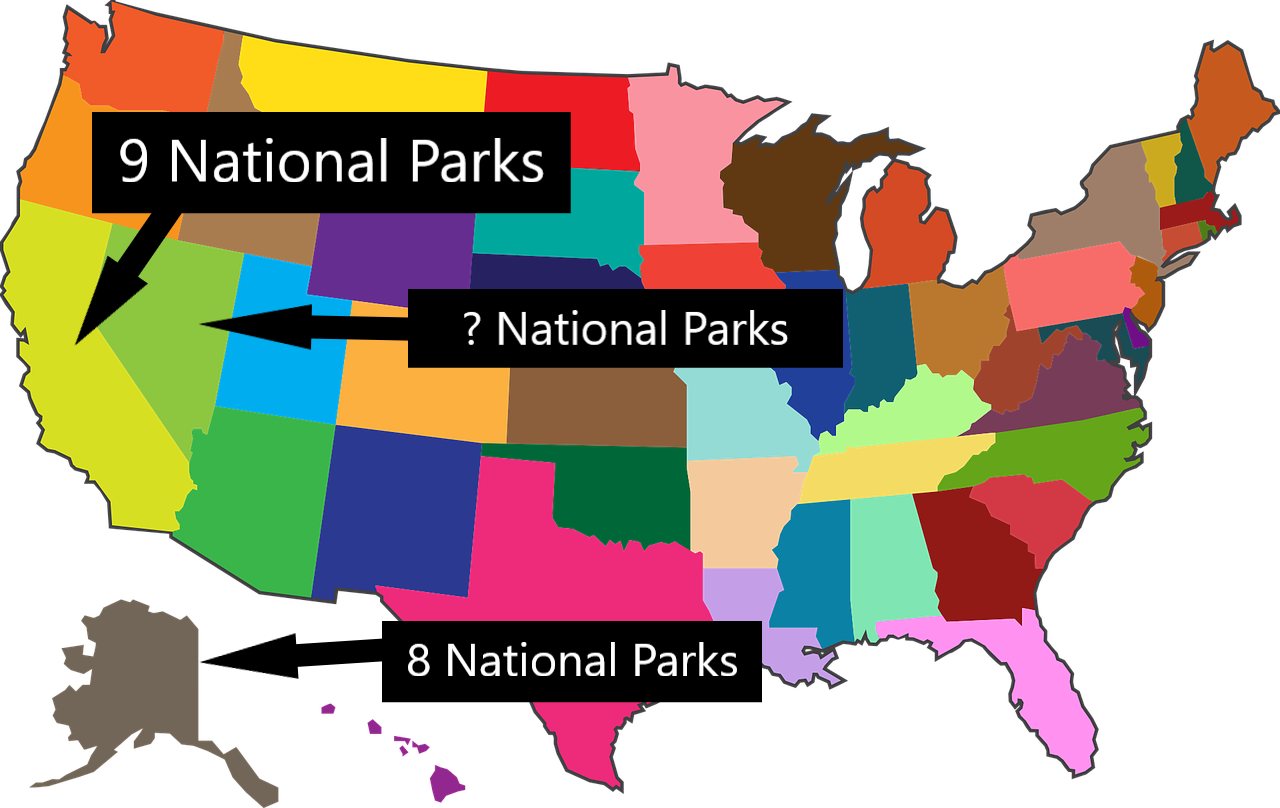
You’d think the biggest state in the union would naturally take the crown for the most national parks. It makes sense, right? Alaska is absolutely massive—so big you could fit Texas inside it twice and still have room for a few smaller states. But when it comes to the specific "National Park" designation, size isn't everything.
California actually has the most national parks in the United States.
As of 2026, the Golden State holds the title with nine official national parks. Alaska sits right behind it with eight. It’s a tight race, and honestly, the "winner" depends on how you define a park. If we were talking about total acreage or "National Park Service units" (which includes monuments and preserves), Alaska would blow everyone out of the water. But for those specific, big-name National Parks? California is king.
Why California dominates the list
California is a bit of a geographical freak of nature. It’s got everything. You can be standing in the lowest, hottest point in North America one morning and be staring at a 14,000-foot peak by the afternoon. This insane diversity is exactly why the state has managed to snag nine spots on the list.
The federal government doesn't just hand out "National Park" status like candy. A place has to have unique geological, biological, or historical value that’s basically irreplaceable. California happens to have a lot of that.
The "Nine" you need to know
Basically, the list is a highlight reel of every ecosystem you can imagine.
- Yosemite: The heavy hitter. If you’ve seen a screensaver of a granite cliff or a massive waterfall, it was probably El Capitan or Yosemite Falls. It’s crowded, yeah, but for a reason.
- Death Valley: It’s the largest park in the lower 48. It’s also incredibly hot. People go there for the salt flats and the "sailing stones" that move across the desert floor on their own.
- Joshua Tree: This is where the Mojave and Colorado deserts meet. It’s famous for those twisty, Seuss-looking trees and some of the best stargazing you’ll ever find.
- Sequoia & Kings Canyon: These two are technically separate but managed together. They’re home to the General Sherman tree—the largest living thing on Earth by volume.
- Redwood: Not to be confused with Sequoia. These are the tall ones. They grow along the foggy northern coast and look like something out of Jurassic Park.
- Channel Islands: You have to take a boat to get here. It’s five islands off the coast of Santa Barbara that feel like the Galapagos of North America.
- Lassen Volcanic: This one is a sleeper hit. It has bubbling mud pots, sulfur vents, and all four types of volcanoes found in the world. It’s basically a mini Yellowstone without the traffic.
- Pinnacles: The newest addition to California’s lineup. It’s known for weird rock spires and being a release site for the endangered California Condor.
Alaska: The runner-up with the most land
Alaska has eight national parks, and they are enormous. Wrangell-St. Elias alone is 13.2 million acres. To put that in perspective, you could fit the entire state of Maryland inside that one park.
The thing about Alaska’s parks is that most of them don't have roads. If you want to see Gates of the Arctic or Kobuk Valley, you aren't driving your SUV there. You’re hiring a bush pilot to drop you off in the middle of nowhere. It’s a much more intense experience than California, which is probably why the "National Park" count is slightly lower—much of the land is designated as "Preserves" to allow for things like subsistence hunting, which isn't typically allowed in standard National Parks.
The "Mighty 5" and other contenders
Utah is the third state on the leaderboard with five parks. They call them the "Mighty 5": Zion, Bryce Canyon, Arches, Canyonlands, and Capitol Reef. If you’ve ever seen those red rock arches on a license plate, that’s Utah.
Colorado comes in fourth with four parks, including Rocky Mountain and Mesa Verde. After that, things start to thin out. Some states, like Arizona or Washington, have three. A huge chunk of the country—mostly in the Midwest and Northeast—has zero or maybe just one.
What most people get wrong about the count
There is a big difference between a "National Park" and a "National Park Service Unit." This is where the confusion usually starts.
The National Park Service (NPS) actually manages over 400 different sites. This includes national monuments, historic sites, battlefields, and seashores. If you count everything the NPS manages, California still ranks high, but Washington D.C. actually has a higher density of sites per square mile.
Also, people often think the Grand Canyon is in the state with the most parks because it's so famous. Nope. Arizona only has three. Fame doesn't equal quantity.
Planning your trip: Tips from the field
If you’re trying to knock out as many parks as possible in one go, California is the obvious choice. You can do a "loop" starting in San Francisco, hitting Yosemite, Sequoia, and Kings Canyon, then heading south to Joshua Tree and Death Valley.
- Get the America the Beautiful Pass. It’s $80. If you’re visiting more than three parks in a year, it pays for itself.
- Book Yosemite early. In 2026, they are still using reservation systems for peak times. Don't just show up and expect to get in.
- Check the weather. Death Valley in July is a death wish. Lassen Volcanic in January is buried in twenty feet of snow.
- Download offline maps. Cell service is non-existent in about 90% of these places.
California’s variety is its biggest strength. You can see a glacier, a desert, a volcano, and an island without ever crossing a state line. It might not be the biggest state, but when it comes to the "National Park" count, it’s holding the trophy for the foreseeable future.
To get the most out of a California park tour, start by mapping out the "Sierra Nevada Trio" (Yosemite, Sequoia, and Kings Canyon). These three are geographically close enough to hit in a single week-long road trip. From there, you can decide if you want to head north to the rainy Redwoods or south to the dry, dramatic landscapes of the Mojave. Just make sure you check for road closures, as mountain passes like Tioga Road in Yosemite often stay closed until June or July due to snow.