History books often make the start of the American Revolution sound like a slow, polite disagreement over tea. It wasn't. It was messy. If you want to understand the moment the fuse was actually lit, you have to look at what were the Intolerable Acts and why they turned moderate colonists into radical rebels overnight.
Imagine waking up and finding out your local harbor—the source of almost every job in your city—is completely blocked by warships. No imports. No exports. No paycheck. That’s exactly what happened to Boston in 1774. The British Parliament didn't call these laws the "Intolerable Acts," of course. They used the much more dignified title of the Coercive Acts. They wanted to "coerce" the colonies back into line. They failed.
Instead of breaking the spirit of the Massachusetts Bay Colony, these laws acted like a giant magnifying glass, showing every other colony from Virginia to Georgia exactly what the British Crown was capable of doing if they got angry enough.
The Boston Tea Party Backlash
To understand the "Intolerable" part, we have to look at the "Coercive" part. Britain was broke. The French and Indian War had drained the royal coffers, and the East India Company was flailing. When a bunch of colonists dressed as Mohawk Indians dumped 342 chests of tea into the harbor on December 16, 1773, King George III had finally had enough. He didn't just want the money back; he wanted to make an example out of Boston.
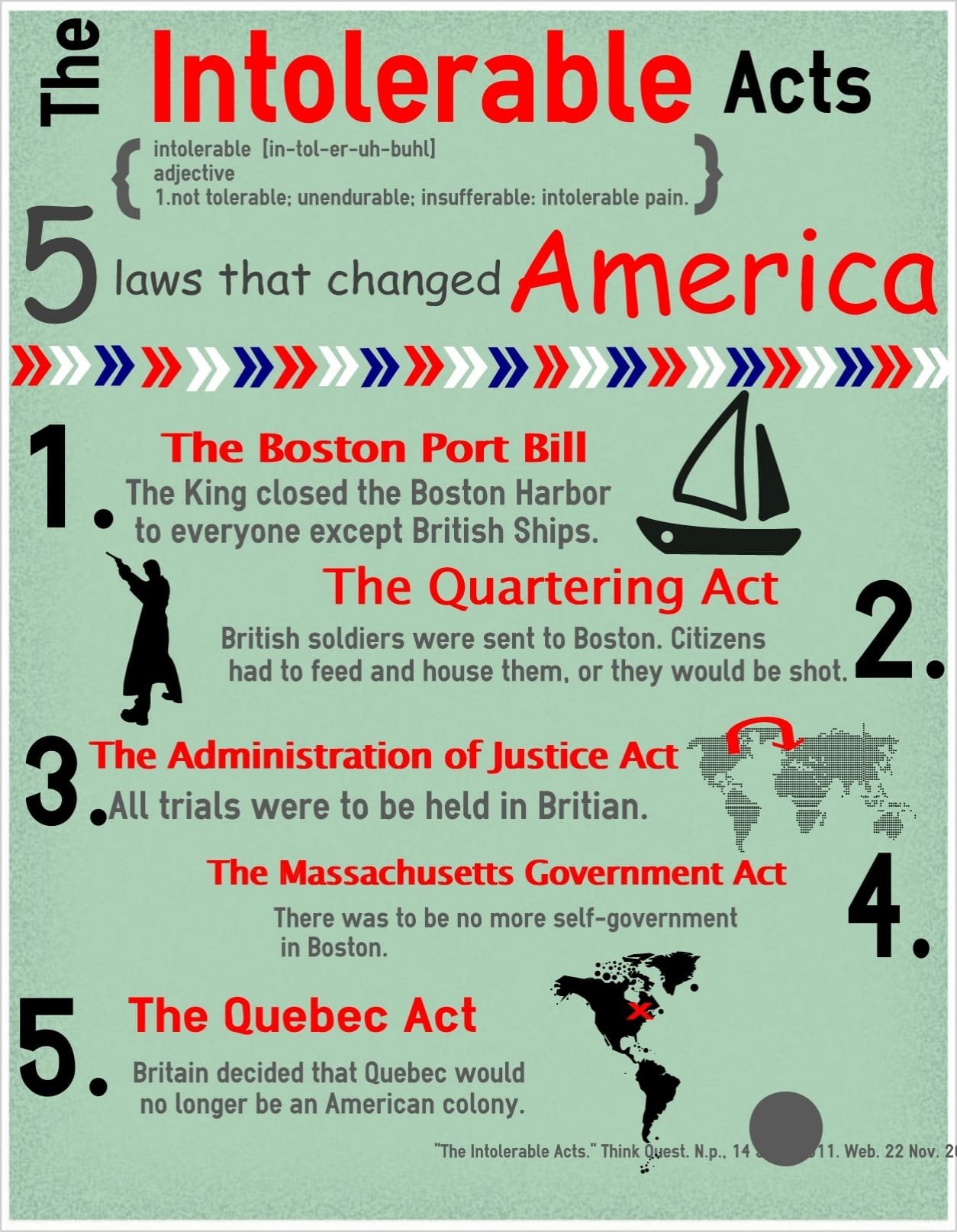
Lord North, the British Prime Minister, basically told Parliament that the time for debating was over. He pushed through four specific laws aimed directly at Massachusetts. A fifth law, the Quebec Act, wasn't technically meant to punish the colonists, but the timing was so bad that everyone lumped it in with the rest.
The first blow was the Boston Port Act. This was the big one. Effective June 1, 1774, the port of Boston was closed. Period. It would stay closed until the colonists paid for every single leaf of ruined tea, which was valued at about £9,000 back then—millions in today’s money. For a city that lived and breathed maritime trade, this was a death sentence.
Stripping Away Self-Rule
If closing the port was the physical punch, the Massachusetts Government Act was the psychological one. It basically ripped up the colony’s 1691 charter. For decades, Massachusetts had enjoyed a high degree of self-governance. They elected their own councils. They held town meetings.
Not anymore.
Under this act, the King’s military governor—General Thomas Gage—gained almost total control. He got to appoint every judge, sheriff, and council member. Most insultingly, town meetings were limited to once a year. If you wanted to meet more than that, you needed the governor's written permission and a pre-approved agenda. It was a total shutdown of local democracy.
Then came the Administration of Justice Act. The colonists had a much catchier name for it: The Murder Act. It allowed British officials accused of capital crimes to be tried back in England or in another colony instead of in Massachusetts. George Washington himself called it the "Murder Act" because he believed a British soldier could now kill a colonist and simply sail home to escape justice. Whether or not that would actually happen didn't matter—the perception was that the British were now above the law.
The Quartering Act and the Quebec Complication
You’ve probably heard of the Quartering Act of 1774. People often think this meant soldiers were sleeping in people's bedrooms. That’s a bit of a myth. It actually allowed the governor to house soldiers in "uninhabited houses, out-houses, barns, or other buildings."
Still, it was a massive invasion of privacy and property rights. It forced the colony to pay for the housing of the very soldiers who were there to keep them under the thumb of the King.
The final piece of the puzzle was the Quebec Act. This one is fascinating because it wasn't a punishment for Boston, but it felt like a betrayal. It expanded the boundaries of the Province of Quebec way down into the Ohio Valley—territory the American colonists had fought for and felt they owned. It also granted religious freedom to Catholics, which, in the heavily Protestant atmosphere of New England at the time, was viewed with deep suspicion.
Why These Acts Backfired So Badly
The British thought they could isolate Massachusetts. They figured the other colonies would look at Boston and think, "Man, I'm glad that's not us. We better behave."
They were wrong. Dead wrong.
Instead of isolating Boston, the Intolerable Acts unified the continent. Food and supplies started pouring into Boston from other colonies. South Carolina sent rice. Pennsylvania sent flour. Virginia sent money. This shared suffering created a sense of "American" identity that hadn't really existed before.
It led directly to the formation of the First Continental Congress in September 1774. Delegates from 12 of the 13 colonies (Georgia sat this one out initially) met in Philadelphia to figure out how to respond. They weren't talking about independence yet—not quite—but they were talking about resistance. They formed the Continental Association to boycott British goods and, perhaps most importantly, they advised colonies to start training their militias.
The Impact on Modern Rights
When you look at the Bill of Rights in the U.S. Constitution today, you can see the scars left by the Intolerable Acts.
The Third Amendment forbids the quartering of soldiers in private homes. The Sixth Amendment guarantees a trial by jury in the location where the crime happened. These weren't just abstract ideas; they were direct reactions to the specific abuses of 1774.
The Intolerable Acts were the "point of no return." Before these acts, a peaceful resolution was at least possible. After them? War was almost inevitable. By the time the British marched on Lexington and Concord in April 1775, the "Intolerable" nature of British rule had already been decided in the minds of the people.
Actionable Insights for History Buffs and Students
If you're researching this topic for a project or just because you're a nerd for the 18th century, keep these specific points in mind to get the full picture:
- Primary Source Check: Read the actual text of the Boston Port Act. It’s dry, legalistic, and reveals the cold bureaucracy behind the punishment.
- The Geography Factor: Look at a map of the Quebec Act's borders. You'll see why Virginia and New York were so angry—their western expansion was essentially cut off.
- Timeline Context: Notice the gap between the Boston Tea Party (Dec 1773) and the first act (March 1774). The British didn't act impulsively; they spent months planning a systematic dismantling of Massachusetts' rights.
- The Economic Ripple: Consider how the closing of one port affected the entire Atlantic trade loop. It wasn't just a Boston problem; it was an empire-wide economic disruption.
Understanding these acts is about more than memorizing dates. It's about seeing how a government's attempt to exert total "order" can actually create the very "chaos" it's trying to prevent. The British wanted a submissive colony; they ended up with a revolution.
To see the transition from protest to war, the next logical step is investigating the proceedings of the First Continental Congress and the Suffolk Resolves, which officially declared the Intolerable Acts unconstitutional. Focus on the language used by Patrick Henry during this period to see how the rhetoric shifted from "British subjects" to "Americans."