If you look at a standard schoolroom map—the kind that uses the Mercator projection—the top of the world looks like a massive, infinite stretch of white. It's easy to assume it’s just a solid block of ice or a weirdly stretched-out continuation of Russia and Canada. But honestly, that’s just a trick of the way we flatten a round Earth onto a square piece of paper.
So, where is Arctic Ocean on the map, exactly?
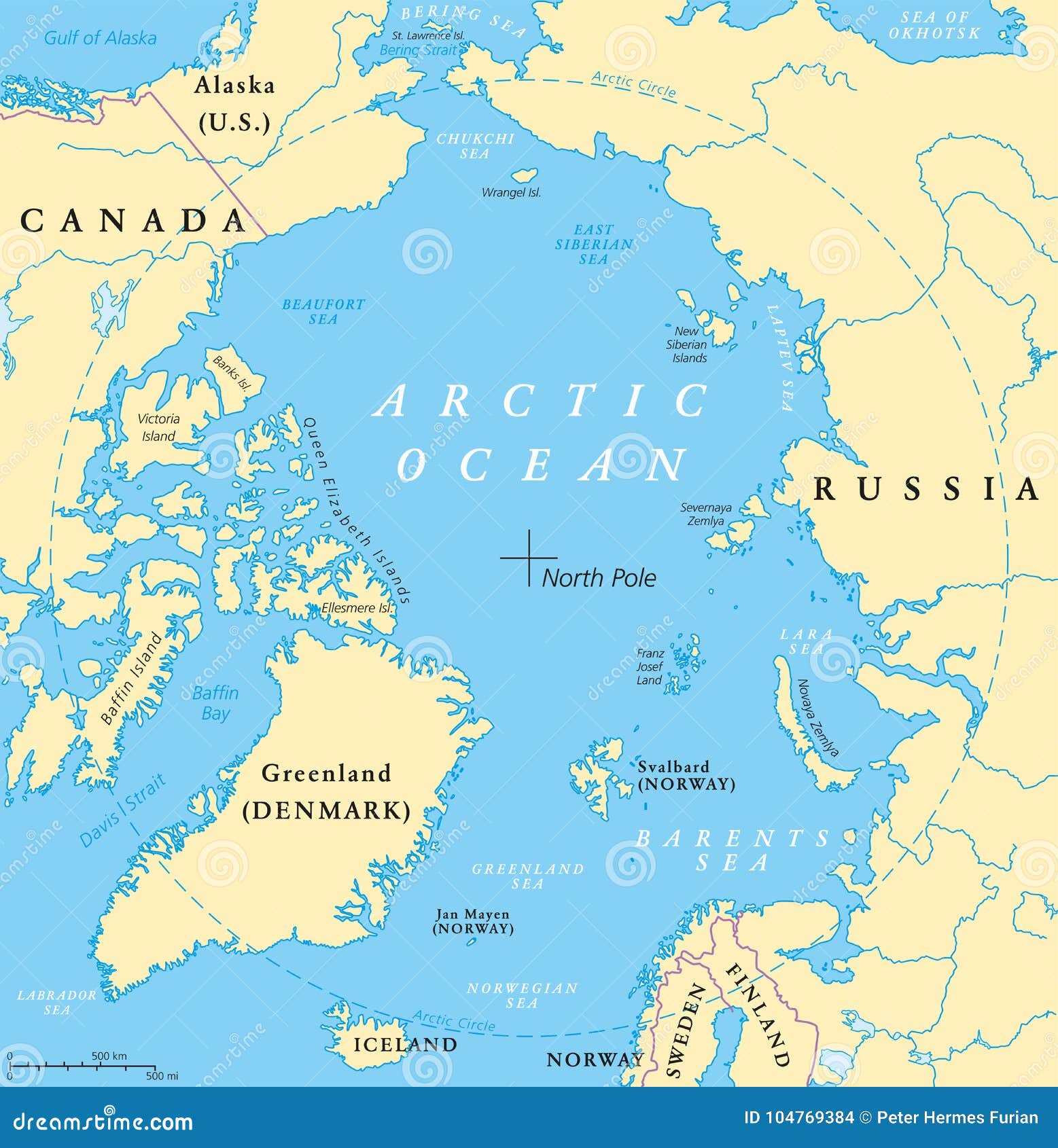
Basically, it sits right at the very top of our planet, centered almost perfectly on the North Pole. It’s the smallest and shallowest of the world's five major oceans, but don't let that fool you into thinking it's just a big pond. It’s roughly 5.4 million square miles. To put that in perspective, it’s about 1.5 times the size of the United States. It's tucked into a circular basin, almost entirely surrounded by the landmasses of North America, Eurasia, and Greenland.
Finding Your Bearings in the High North
When you're trying to spot it on a globe, you’ve gotta look for the "Blue Mediterranean of the North." That's what some oceanographers call it because it’s so enclosed by land.
If you're tracing the edges, you’ll see it’s bounded by:
- The northern coasts of Russia (which has the longest Arctic coastline).
- Norway and its Svalbard archipelago.
- Greenland (governed by Denmark).
- The Canadian Arctic islands.
- Alaska in the United States.
It’s connected to the Pacific Ocean through the narrow Bering Strait between Alaska and Russia. On the other side, it opens up into the Atlantic through the Greenland Sea and the Labrador Sea. It’s a tight squeeze compared to the wide-open Pacific or Atlantic.
Why Your Map Probably Lies to You
Most maps you’ve seen since 1st grade are "distorted." Because the Earth is a sphere, mapmakers have to stretch the areas near the poles to make them fit into a rectangle. This makes the Arctic Ocean look like a flat, endless strip across the top.
If you want the real deal, you need to look at a Polar Projection.
In a polar projection, the North Pole is the center of the circle, and the Arctic Ocean looks like a roundish Mediterranean-style sea. You’ll see it’s actually a complex basin divided by massive underwater mountain ranges like the Lomonosov Ridge. This ridge is wild—it’s an underwater mountain chain that stretches 1,100 miles across the ocean floor, effectively splitting the ocean into two sub-basins: the Eurasia Basin and the Amerasia Basin.
Is It Land or Water?
One of the biggest things people get wrong—and I mean really wrong—is thinking the Arctic is like Antarctica.
Antarctica is a continent covered in ice. The Arctic is an ocean covered in ice. You can't technically "stand" on the North Pole in the same way you stand on the South Pole because there’s no land underneath you. You’re standing on sea ice that’s floating over roughly 13,000 feet of water.
Wait, it gets weirder.
There isn't just one North Pole. On a map, you’re looking at the Geographic North Pole (90° N). But there's also the Magnetic North Pole, which is where your compass points. This spot actually moves. Right now, it’s drifting away from the Canadian Arctic toward Siberia at a rate of about 34 miles per year. If you tried to pin it on a paper map, you’d have to use a pencil because you’ll be erasing and moving it every few years.
The Real Boundaries You Won't See on a Map
Geographers don't just use coastlines to define where the Arctic starts. They use three main "invisible" lines:
- The Arctic Circle (66° 33’ N): This is the famous one. North of this line, the sun doesn't set on the summer solstice and doesn't rise on the winter solstice.
- The 10°C Summer Isotherm: This is a fancy way of saying "the line where it stays cold." It’s a boundary where the average temperature in the warmest month (July) is 10°C (50°F).
- The Treeline: This is a biological boundary. It’s where it gets too cold and the soil stays too frozen (permafrost) for trees to grow.
These lines don't always match up. Some people in the Bering Sea are technically south of the Arctic Circle but live in "Arctic" conditions. It’s a bit of a "choose your own adventure" depending on whether you’re a biologist, a sailor, or a politician.
The Changing Face of the Map
If you look at a map from twenty years ago, the Arctic Ocean is depicted as a solid white mass. Today? Not so much.
Because of climate change, the "permanent" ice pack is shrinking. We’re seeing more "blue water" on the map every summer. This is opening up two major shipping shortcuts that used to be impossible:
- The Northwest Passage: Winding through the Canadian Arctic islands.
- The Northern Sea Route: Running along the Russian coast.
By 2026, these routes are becoming more than just explorer legends; they are active lanes for massive cargo ships. What used to be a 15,000-mile trip from East Asia to Europe through the Suez Canal is now a 7,000-mile trip across the top of the world.
Why You Should Care Where It Is
Knowing where the Arctic Ocean sits isn't just for winning trivia nights. It's the world's air conditioner. The white ice reflects sunlight back into space (the albedo effect). As the ice melts and the map shows more dark blue water, that water absorbs heat instead of reflecting it.
Also, it’s a geopolitical hotspot. Because the Arctic floor is rich in oil, gas, and minerals, countries like Russia, Canada, and the U.S. are all arguing over who "owns" which part of the seafloor. If you look at a map of "territorial claims," it looks like a pie sliced into very messy, overlapping pieces.
Common Myths to Stop Believing
Let’s clear some stuff up.
- Penguins? Nope. Never. Penguins are strictly Southern Hemisphere. If you see a drawing of a polar bear and a penguin together, that artist failed geography.
- It’s always dark? Only in winter. In the summer, it’s 24/7 daylight. It’s actually quite beautiful, with "midnight sun" that just hovers on the horizon.
- Nobody lives there? Roughly 4 million people live in the Arctic. From the Inuit in North America to the Saami in Scandinavia, people have been mapping this area in their heads for thousands of years before we had satellites.
Actionable Next Steps for Visualizing the Arctic
If you really want to understand where the Arctic Ocean is on the map, a flat 2D screen won't cut it. Do these things to get a real sense of the "top of the world":
- Use Google Earth’s "Voyager" Mode: Instead of looking top-down, tilt the view. Fly from Alaska across the pole to Norway. You’ll realize how "close" Russia and the U.S. actually are across the ice.
- Check the NSIDC Daily Image: The National Snow and Ice Data Center (NSIDC) provides a daily satellite map of the Arctic sea ice extent. It shows you exactly where the "land" of ice ends and the "open" ocean begins today.
- Search for an "Orthographic" Map: This is a map that looks like a photo of a globe. It’s the only way to see the Arctic Ocean without the massive distortion that makes it look like a flat white pancake.
- Explore the Lomonosov Ridge: Look up bathymetric maps (underwater maps). Seeing the "mountains" under the North Pole helps you understand why countries are fighting over the territory—it's about the continental shelf, not just the water.
The Arctic isn't just a white void at the top of your map. It’s a dynamic, shifting, and incredibly deep ocean that is currently changing faster than anywhere else on Earth.