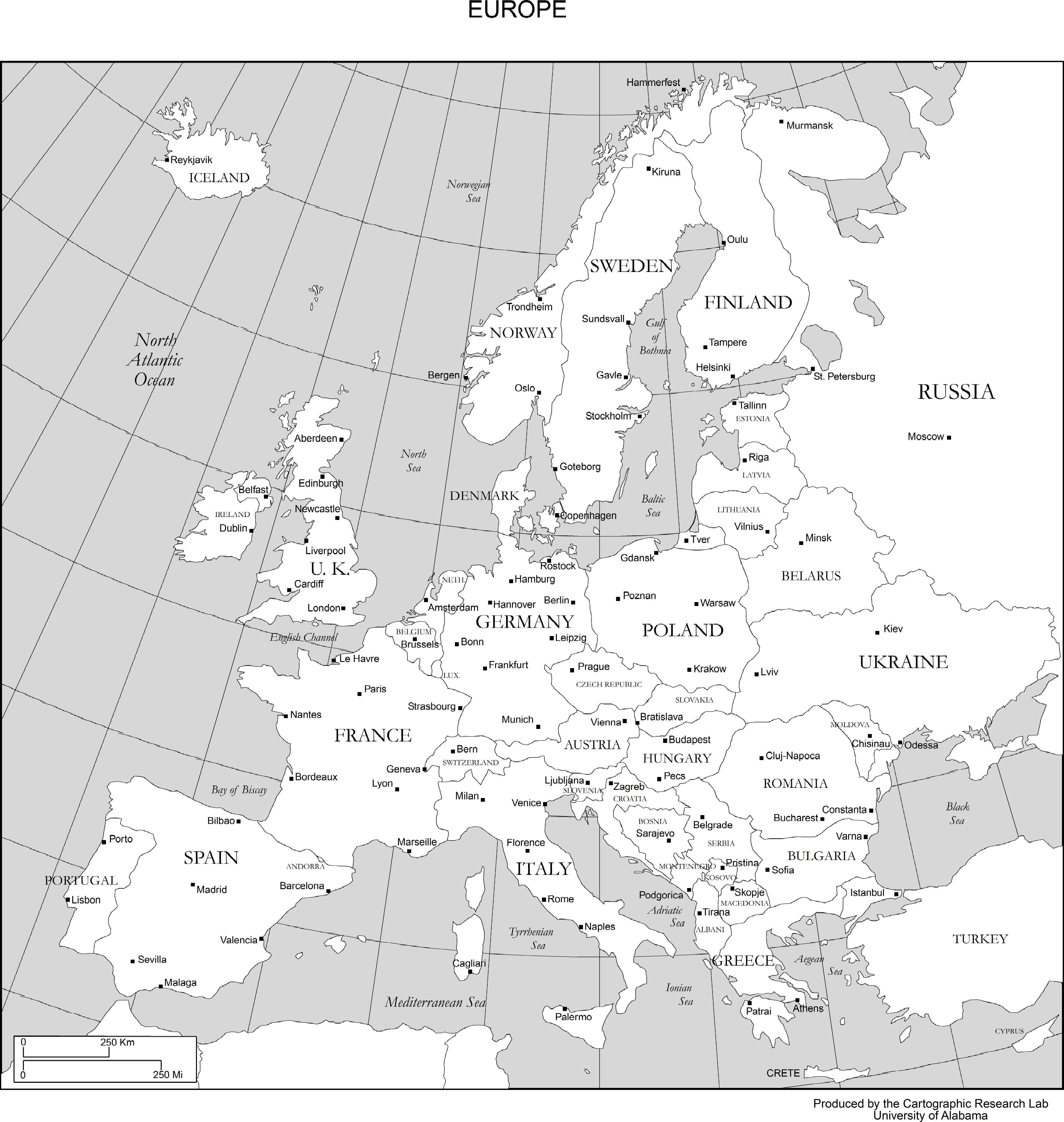
If you look at a globe, Europe looks like a total afterthought. It’s this weirdly shaped, jagged little peninsula sticking off the side of the massive Asian landmass. Honestly, if we were being strictly scientific about tectonic plates and giant chunks of rock, Europe shouldn't even be its own continent. Geologically speaking, it's just the western end of Eurasia.
But humans love categories. We love drawing lines in the dirt and saying, "This side is different from that side." So, when someone asks where is Europe on the map, the answer depends entirely on whether you’re asking a geologist, a politician, or a high school geography teacher.
Europe is mostly tucked into the Northern Hemisphere and squeezed into the Eastern Hemisphere. It’s tiny. We’re talking about the second-smallest continent on the planet, beating out only Australia. Yet, it manages to pack about 50 countries into that space, depending on who’s counting and how they feel about the Caucasus region that week.
The Invisible Border: Where Europe Actually Ends
The weirdest part about finding Europe on a map is that its eastern border is basically a "vibe" that everyone just agreed on a few centuries ago. To the north, you’ve got the Arctic Ocean. To the west, the Atlantic. To the south, the Mediterranean Sea. Those are easy.
But the east? That’s where things get messy.
The traditional "official" border runs down the Ural Mountains in Russia. It then follows the Ural River into the Caspian Sea, cuts across the Caucasus Mountains, and hits the Black Sea. From there, it threads through the Bosporus Strait in Turkey and out into the Mediterranean.
The Transcontinental Identity Crisis
Because these borders cut right through countries, some nations live in two worlds at once.
- Russia: About 75% of its people live in the "European" part, but most of its land is in Asia.
- Turkey: Istanbul is literally split in half. You can eat breakfast in Europe and take a ferry to Asia for lunch.
- Kazakhstan: A tiny sliver of this Central Asian giant actually sits on the European side of the Ural River.
It’s kinda wild that a single river can determine which continent you’re standing on, but that’s how the map works. If you're looking for the heart of the continent, most geographers point to the Land Hemisphere. If you tipped the Earth to show the half with the most land, Europe sits right in the middle. This "relative location" is basically why Europe became a global trade hub; it was just closer to everything else by sea.
Why the Map Looks the Way It Does
Maps aren't just objective pictures of the ground. They are historical arguments. For a long time, the boundary of Europe was the Don River. Then, in the 1700s, a Swedish guy named Philip Johan von Strahlenberg decided the Urals made more sense. He was a prisoner of war in Russia, and his map eventually became the standard.
Why does this matter? Because it defines who is "European."
When you look at where is Europe on the map today, you're seeing the result of the Cold War, the rise of the European Union, and ancient Greek mariners who just wanted to name the land they saw across the water. The Greeks named the lands to their west "Europa" and the lands to their east "Asia."
The Peninsula of Peninsulas
Europe is basically a collection of arms reaching into the sea. You’ve got the Scandinavian Peninsula in the north, the Iberian Peninsula (Spain and Portugal) in the southwest, the Italian Peninsula (the boot), and the Balkans in the southeast.
Because of all this water, no place in Europe is truly "landlocked" in the way central Asia or Africa can be. Even the middle of Germany is just a few hours' drive from a coast. This proximity to water isn't just for beach days—it’s the reason Europe stays warm.
The Gulf Stream brings hot water from the Gulf of Mexico across the Atlantic. This is why London isn't a frozen wasteland. London is further north than Calgary, Canada, but Londoners rarely deal with -30°C winters. The ocean acts like a giant radiator for the whole continent.
Navigating the Subregions
If you’re staring at a map trying to make sense of the 50-ish countries, it helps to break it down. Most travel guides and the UN use these four buckets:
- Northern Europe: The "Viking" countries like Norway, Sweden, and Denmark, plus the Baltics (Estonia, Latvia, Lithuania) and the UK/Ireland.
- Western Europe: The heavy hitters like France, Germany, Belgium, and the Netherlands.
- Southern Europe: The Mediterranean sun-seekers—Italy, Greece, Spain, and Portugal.
- Eastern Europe: A huge, diverse area including Poland, Ukraine, Romania, and the European part of Russia.
There’s also Central Europe, which includes places like Austria, Hungary, and Czechia. People in Prague will get very annoyed if you call them "Eastern European." To them, they are the literal center of the map.
The Extreme Points of the Map
If you wanted to stand on the "edges" of Europe, here is where you’d go:
- North: Cape Nordkinn in Norway (on the mainland) or Svalbard if you count islands.
- South: Punta de Tarifa in Spain. You can see Africa from here; it's only 9 miles away across the Strait of Gibraltar.
- West: Cabo da Roca in Portugal. There’s a monument there that says it's "where the land ends and the sea begins."
- East: The high peaks of the Ural Mountains.
Actionable Insights for Map Enthusiasts
Understanding Europe's location isn't just about trivia. It changes how you plan travel and understand news.
- Check the "Schengen" vs. "Europe": Just because a country is on the map of Europe doesn't mean you can travel there freely. The UK is in Europe but not in the Schengen Area. Switzerland is in Schengen but not the EU. Always check visa requirements based on political maps, not just geographic ones.
- Watch the Weather Patterns: Because Europe is a peninsula, the weather changes fast. If you're traveling in the "Transcontinental" zone (like Georgia or Turkey), you can go from Mediterranean heat to Alpine snow in a single afternoon.
- Look Beyond the Big Names: Most people focus on the "Blue Banana"—a corridor of urbanization stretching from England to Italy. But the geographic center of Europe is actually near a tiny village in Lithuania (or Belarus, or Slovakia, depending on which mathematician you ask).
Europe is a small place with a very loud history. Finding it on a map is easy; agreeing on where it starts and ends is the part that’s kept geographers busy for 2,000 years. Next time you're looking at a world map, remember that the thin line between the Black and Caspian seas isn't just a border—it's a centuries-old debate about identity.
Go ahead and pull up a digital map and trace the Ural River down to the Caspian Sea. You'll see exactly how "Asia" and "Europe" are really just two names for the same giant rock.