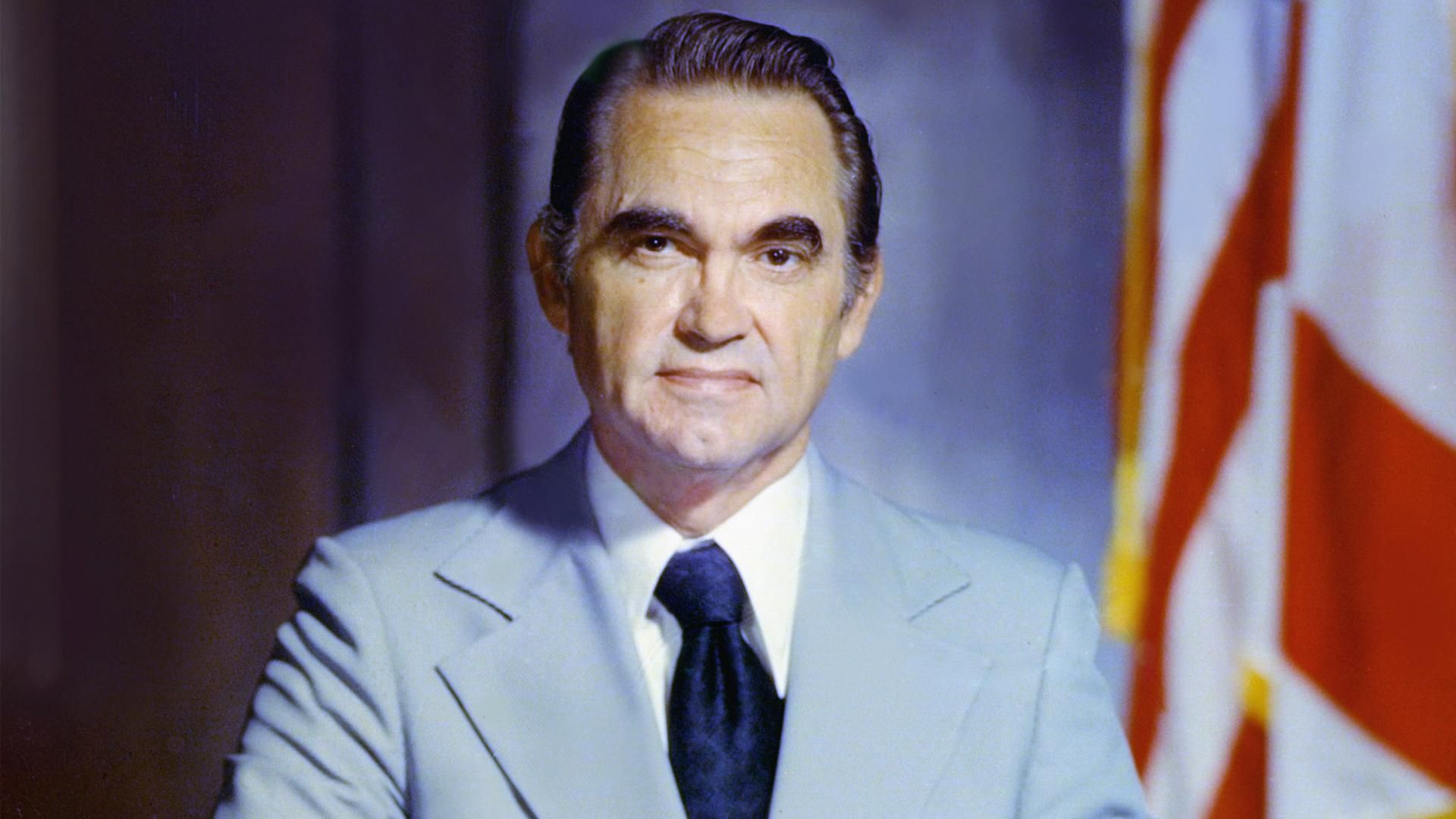
He stood in the schoolhouse door. That is the image most people have when they ask who was George Wallace. It’s a grainy, black-and-white moment from 1963 where a defiant man in a suit tries to block the federal government from integrating the University of Alabama. It’s a powerful visual, but honestly, it only scratches the surface of a man who was probably the most influential "loser" in American political history. Wallace never became president, yet he basically wrote the playbook for the modern culture wars that still dominate our news feeds today.
He was a bantamweight boxer in his youth, and he carried that pugilistic energy into every corner of his political life. To understand Wallace, you have to understand a man who started as a moderate—at least by the standards of 1950s Alabama—and then pivoted hard toward hardline segregation because he realized it was the only way to win. It was a cynical, effective, and ultimately destructive transformation. He once famously said he was "out-nigguhed" in his first race for governor, and he swore it would never happen again. He kept that promise.
The Man Behind the Segregationist Mask
Wallace wasn't always the firebrand we remember. Early in his career, he was actually considered a protégé of "Big Jim" Folsom, a populist governor who was relatively progressive on race. When Wallace served as a circuit judge, he was known for being fair to Black lawyers—a rarity in the Jim Crow South. But after losing the 1958 gubernatorial primary to a candidate backed by the Ku Klux Klan, Wallace's politics shifted. He didn't just change his platform; he changed his soul.
By 1963, when he finally took the oath as Governor of Alabama, he delivered a speech written by Asa Carter, a KKK member and later a Western novelist. That’s where the infamous line came from: "Segregation now, segregation tomorrow, segregation forever."
It wasn't just rhetoric. He used the state police to crack down on civil rights marchers in Selma. He encouraged a climate of violence that led to the bombing of the 16th Street Baptist Church. When you ask who was George Wallace, you’re asking about a man who provided the political cover for some of the darkest moments of the 20th century. He was the "fighting little judge" who fought against the tide of history, and for a long time, it looked like he might actually win.
A National Force: The 1968 and 1972 Campaigns
Most people forget that Wallace wasn't just an Alabama phenomenon. He took his show on the road. In 1968, running as a third-party candidate for the American Independent Party, he pulled nearly 10 million votes. He won five states in the Deep South. That's a staggering number for someone seen by the Northern establishment as a fringe extremist.
How did he do it? He was a master of what we now call "populism." He didn't just talk about race; he talked about "pointy-headed bureaucrats" in Washington who couldn't park a bicycle straight. He talked about "law and order." He spoke to the fears of the white working class in places like Michigan and Wisconsin, not just Alabama. He realized that the grievances of a factory worker in Gary, Indiana, weren't all that different from a farmer in Selma.
He tapped into a vein of resentment against the "liberal elites" that remains a cornerstone of American politics. Richard Nixon watched Wallace closely and basically stole his "Southern Strategy" to build the modern Republican coalition. Wallace was the blueprint.
The Shooting at Laurel, Maryland
The 1972 campaign felt different. Wallace was running as a Democrat this time, and he was winning primaries. He was no longer just a regional candidate; he was a legitimate threat to the frontrunners. Then, on May 15, 1972, at a shopping center in Maryland, a man named Arthur Bremer stepped out of the crowd and fired five shots.
Wallace survived, but he was paralyzed from the waist down for the rest of his life.
The image of the defiant boxer was gone, replaced by a man in a wheelchair, constantly in pain. This is where the story gets weird. Most villains in history stay villains until the end. Wallace, however, went on a journey of public repentance that many still debate today.
The Great Apology: Sincere or Strategic?
In the late 1970s, Wallace began reaching out to the very civil rights leaders he had once oppressed. He went to Black churches. He met with John Lewis. He asked for forgiveness. He claimed that his stance on segregation had been wrong—not just politically, but morally.
"I was wrong. Those days are over, and they ought to be over," he told a crowd at the Dexter Avenue Baptist Church, the same church where Martin Luther King Jr. once preached.
- 1979: Wallace contacts civil rights leaders to ask for a meeting.
- 1982: He runs for his final term as governor with the support of Black voters.
- Late 80s: He spends his final years in relative isolation, plagued by health issues.
Critics say it was a calculated move to stay relevant in a "New South" where Black people could finally vote. Others, including some Black leaders who knew him, believed he was a broken man truly seeking redemption before he met his Maker. He won his final term as governor in 1982 largely because of the Black vote. Think about that for a second. The man who stood in the schoolhouse door was put back in the governor’s mansion by the people he tried to keep out.
Why George Wallace Still Matters in 2026
You can't understand modern American elections without understanding Wallace. He was the first to realize that "culture" is a more powerful political tool than "policy." He knew that if you could make people feel like their way of life was under attack by an out-of-touch elite, they would follow you anywhere.
We see his ghost in every debate about "cancel culture," every "law and order" campaign, and every populist movement that pits the "real people" against the "establishment." He was the original disruptor.
When people ask who was George Wallace, the answer is a warning. He is a case study in how a talented politician can use fear to gain power, and how a legacy can be both a blueprint for success and a permanent stain on a man's name. He died in 1998, mostly deaf and in constant pain, a shadow of the man who once defied the federal government.
Digging Deeper into the Wallace Legacy
If you really want to get the full picture, don't just take my word for it. There are a few key resources that provide a much deeper dive into the nuances of his life and the era he helped define:
- Read "The Politics of Rage" by Dan T. Carter. This is widely considered the definitive biography. Carter doesn't hold back on the damage Wallace did, but he also explains why it worked. It’s essential for understanding the link between Wallace and modern conservatism.
- Watch "George Wallace: Settin' the Woods on Fire." This PBS documentary features incredible footage of his rallies. You need to see his energy and his connection with the crowd to understand why he was so dangerous to the status quo.
- Visit the Civil Rights Memorial in Montgomery. Standing where Wallace gave his "Segregation Forever" speech and then walking a few blocks to the memorials for those who died fighting his policies provides a visceral sense of the stakes involved.
The most important takeaway from the life of George Wallace is that politics isn't just about who wins an election; it's about the forces they unleash. Wallace unleashed forces of division that the United States is still trying to reconcile decades later. His life was a journey from moderate to extremist to penitent, but the echoes of his "schoolhouse door" era are the ones that still ring the loudest in the American psyche.
To truly understand the current political climate, look past the headlines and look back at the man from Clio, Alabama. He saw the future of American politics, and for better or worse, we are living in it.