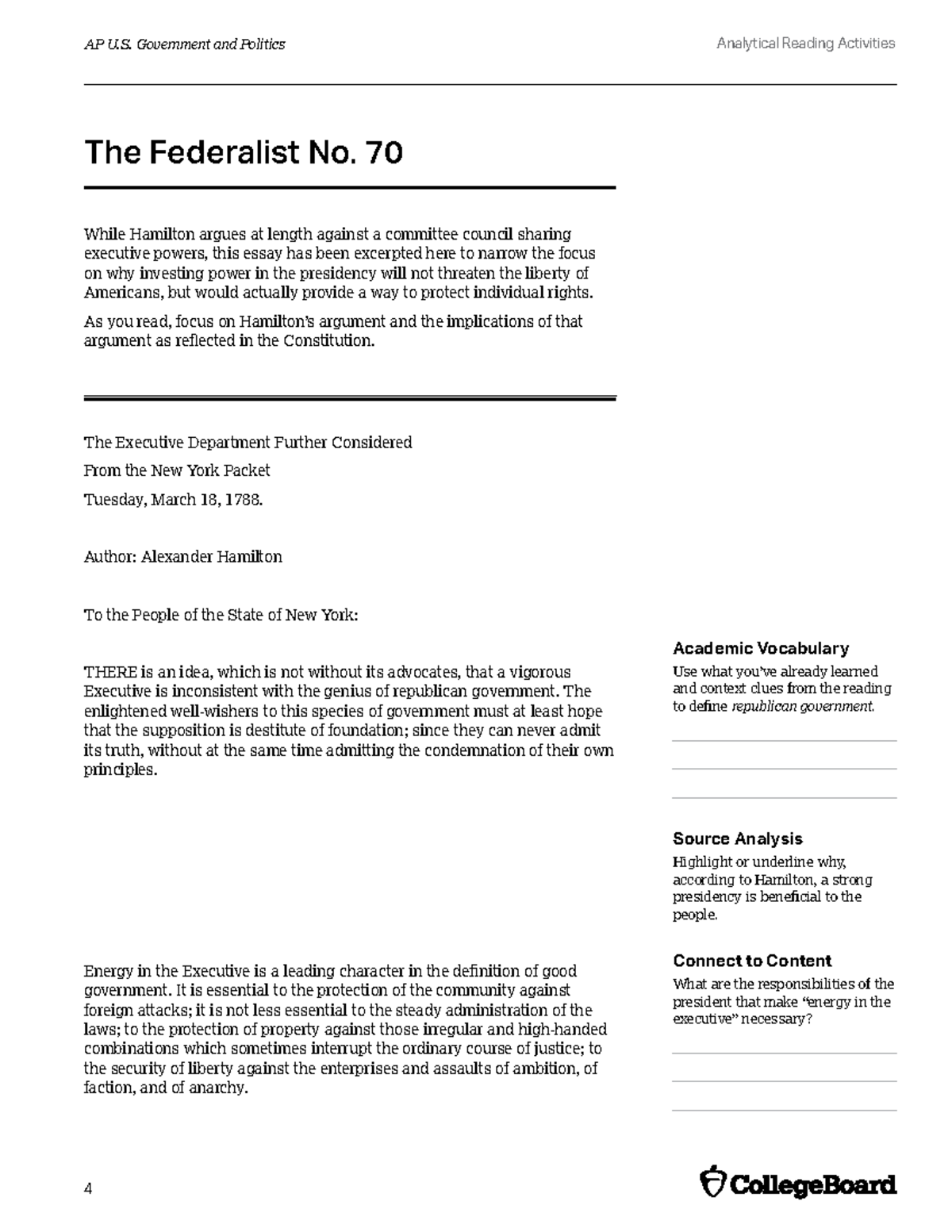
When you look at the American presidency today, you see a single person holding an immense amount of power. It’s a "unitary executive." But back in 1788, this was a terrifying concept for a lot of people who had just finished fighting a war against a king. They were nervous. They were skeptical. And they needed to be convinced that one person at the top was better than a committee. That’s where the question of who wrote Federalist 70 becomes so central to understanding how the United States actually functions.
The short answer? Alexander Hamilton.
He didn't just write it; he obsessed over it. Hamilton was the primary architect of the "energetic" executive branch. While James Madison was busy figuring out the legislature and John Jay was dealing with foreign policy (until he got sick), Hamilton took on the task of defending the idea that a strong, single president wasn't just a good idea—it was a survival necessity for the young nation.
The Man Behind the Pen: Alexander Hamilton’s Vision
It's funny how we think of the Federalist Papers as this unified front. In reality, it was a desperate, fast-paced PR campaign. Hamilton wrote the lion's share of the 85 essays. By the time he got to number 70, he was really hitting his stride on executive power.
Hamilton was a bit of an outlier among the Founders. He had a deep-seated fear of instability. He’d seen the chaos of the Articles of Confederation, where the government was basically a "rope of sand." To him, a government without a strong head was like a body without a brain. It couldn't move. It couldn't react.
He wrote Federalist 70 to counter the "Anti-Federalists"—critics like Patrick Henry or the writer known as "Cato"—who thought a single president looked way too much like a British monarch. They wanted an executive council. Hamilton thought that was a recipe for disaster. He argued that "energy in the Executive is a leading character in the definition of good government." Without that energy, the government would be "feeble," and a feeble government is, quite simply, a bad government.
Why One President is Better Than Two (or Three)
Hamilton’s main argument in Federalist 70 is about "unity." He makes a case that sounds almost modern in its efficiency. He basically says that if you have more than one person in charge, they are going to argue. They’re going to develop personal whims and hidden agendas.
Think about it.
If you have a council of three people trying to run a war or respond to an emergency, they’re going to hesitate. They’ll bicker. Hamilton warns that "the most important measures of government" would be "impeded or frustrated by the dissensions and animosities of the persons charged with them."
But there’s a more clever, almost sneaky reason Hamilton wanted just one person. Accountability.
This is the part most people forget. Hamilton argued that if you have a group of people in power and something goes wrong, they all start pointing fingers at each other. "It wasn't me, it was him!" "I was outvoted!" If you have one president, there is nowhere to hide. You know exactly who to blame. You know exactly who to vote out in the next election. He calls this "the restraints of public opinion." By having a single person, that person is more "narrowly watched" by the people.
The Ingredients of Executive Energy
Hamilton didn't just want a guy in a suit; he wanted four specific things to make the presidency work:
- Unity: One person, not a group.
- Duration: A long enough term to actually get stuff done (he didn't want the president constantly worried about the next election).
- An adequate provision for its support: Basically, a salary that couldn't be messed with by Congress to bribe or starve the president into submission.
- Competent powers: The actual legal authority to act.
He balances this "energy" against "safety." He knew he had to sell this to a crowd that hated kings. So, he argued that while the legislature should be slow and deliberative (to represent the people's various interests), the executive must be fast.
The Anti-Federalist Pushback
It’s important to realize that Hamilton wasn't just shouting into a void. He was in a heated debate. People like George Mason and the authors of the Anti-Federalist Papers were genuinely worried. They saw Federalist 70 as a blueprint for elective despotism.
They argued that a single executive would naturally surround himself with "favorites" and "flatterers." They feared that the president would become a "fetus of monarchy," a phrase used by Edmund Randolph. They preferred the idea of a council because they believed "in the multitude of counselors there is safety."
Hamilton’s response was essentially: "Safety in a council is actually a trap." He argued that a council provides a "cloak" for mistakes. It hides the truth from the public. If a council makes a bad decision, the public is confused about who to hold responsible. Honestly, his logic won out because the Articles of Confederation had already proven that a weak, committee-based government was failing.
Federalist 70 in the Modern Era
Does this 18th-century essay still matter? Ask any lawyer in the Department of Justice. The "Unitary Executive Theory," which is cited constantly in modern Supreme Court cases, traces its roots directly back to what Hamilton wrote in Federalist 70.
Whether it’s a president using an executive order to change immigration policy or a president claiming "executive privilege" to keep documents from Congress, the ghost of Hamilton is in the room. When the Supreme Court decides cases like Seila Law LLC v. Consumer Financial Protection Bureau or Trump v. United States, they are often debating whether the president has the "unity" and "energy" Hamilton described, or whether Congress has the right to limit that power.
Hamilton’s vision has, in many ways, triumphed. The American president is arguably the most powerful individual in the world. But the trade-off he promised—that one person would be easier to hold accountable—is still a subject of massive debate. Is a modern president actually more accountable, or has the office become so large that the "unity" Hamilton envisioned is impossible?
Key Takeaways for Students of History
If you're studying this for a class or just curious about the roots of American power, here are the non-negotiable facts you need to keep straight:
- Primary Author: Alexander Hamilton wrote it under the pseudonym "Publius."
- Core Theme: The necessity of a "vigorous" and "energetic" single executive.
- Main Argument: A single president is more efficient than a council and easier for the public to hold accountable.
- Historical Context: Written to convince the state of New York to ratify the Constitution.
Actionable Insights for Understanding Executive Power
To truly grasp the impact of who wrote Federalist 70, you shouldn't just read the text; you should look at how it's applied today. Start by looking up recent Supreme Court rulings that mention "The Unitary Executive." You'll see Hamilton's name or his logic pop up almost every time.
If you want to dive deeper, compare Federalist 70 with Federalist 10 (written by Madison). You'll see a fascinating contrast: Madison focuses on how to break up power to prevent tyranny, while Hamilton focuses on how to concentrate power to ensure the government actually works.
Understanding this tension—between the need for a government that is "safe" and a government that is "energetic"—is the key to understanding the American political system. It’s a balance we’re still trying to strike over 200 years later. Hamilton’s essay wasn't just a defense of the Constitution; it was a prophecy of how the American presidency would eventually become the center of the political universe.
The best way to see this in action is to watch how a president reacts to a national crisis. In those moments, the "energy" Hamilton talked about is usually what people are clamoring for, regardless of their political party. We want a leader who can act. We want someone who doesn't have to wait for a committee to vote before they can protect the country. That is the lasting legacy of Alexander Hamilton's 70th essay.
Next Steps for Research
- Read the original text of Federalist 70 to identify Hamilton's specific use of the word "secrecy" as a virtue of the presidency.
- Examine the Anti-Federalist Paper "Cato No. 4" to see the most famous rebuttal to Hamilton’s arguments.
- Research the "Removal Power" cases in the Supreme Court to see how Federalist 70 is used as legal precedent today.