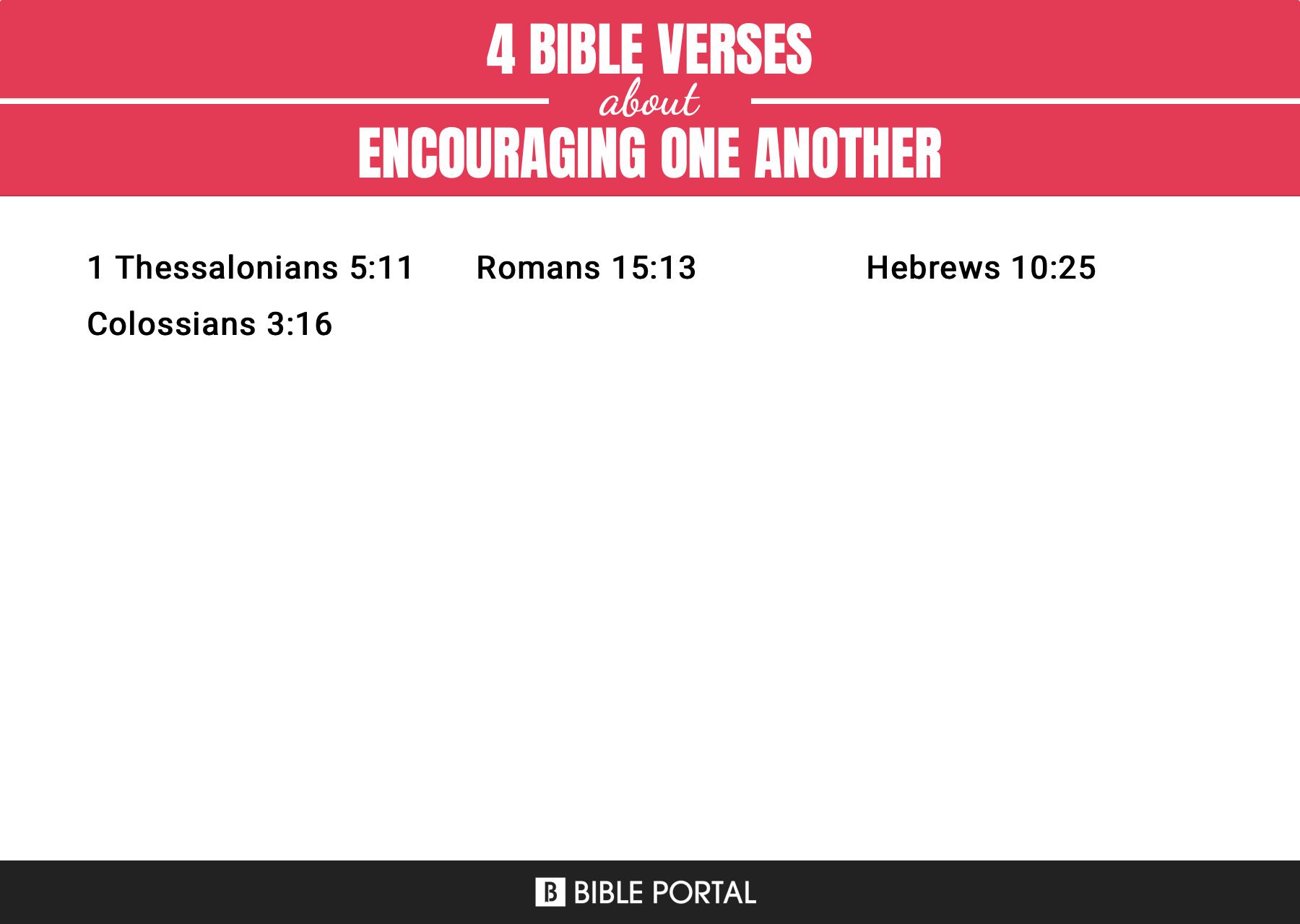
Life is a grind. You know it, I know it, and honestly, the people who wrote the New Testament definitely knew it. They weren't sitting in air-conditioned offices typing out "live, laugh, love" posters. They were dealing with shipwrecks, prison cells, and the constant threat of being cancelled—permanently. When we look at bible scriptures on encouraging one another, we aren't just looking at ancient "hang in there" memes. We are looking at a survival strategy for the soul.
Think about it.
Most people think of encouragement as a pat on the back. It's that "you got this!" text you send to a friend who’s nervous about a job interview. But the Greek word often used in the New Testament is parakaleō. It’s beefier than our English version. It means to call someone to your side. It’s a summons. It’s basically saying, "Hey, get over here, I’m not letting you sink."
The Hebrew Roots of "Holding Up Arms"
Long before the famous letters of Paul, there’s this weirdly specific story in Exodus 17. The Israelites are in a battle. As long as Moses holds his hands up, they win. If he drops them, they start losing. But here's the thing: Moses is human. His arms got heavy. He couldn't do it alone. So, Aaron and Hur grabbed a stone for him to sit on and literally held his hands up for him.
That is the rawest definition of encouragement you’ll ever find. It wasn’t a motivational speech. It was physical, exhausting support. When we talk about bible scriptures on encouraging one another, we’re talking about becoming the "Aaron or Hur" for someone whose "arms" are failing.
What 1 Thessalonians 5:11 Actually Demands From Us
"Therefore encourage one another and build each other up, just as in fact you are doing."
You've probably seen that on a coffee mug. But look at the context. Paul was writing to a group of people who were genuinely terrified about the future. They were worried about death and the end of the world. He didn't tell them to just "have faith." He told them to build.
The word "build" here is oikodomeō. It's a construction term. It implies that every interaction we have is either adding a brick to someone’s foundation or knocking a hole in their wall. There’s no neutral ground. You're either a builder or a wrecking ball.
Honestly, it’s a lot of pressure. But it’s also incredibly practical. If you’re wondering how to actually do this without being cheesy, look at how these early communities functioned. They shared meals. They shared money. They shared their messes.
Why Hebrews 10:24-25 Isn't Just About Showing Up to Church
This is the big one. People love to quote this to guilt-trip folks into sitting in a pew on Sunday morning. "Let us consider how we may spur one another on toward love and good deeds, not giving up meeting together... but encouraging one another."
But look at that word "spur." Some translations use "provoke."
It’s an aggressive word!
It’s like a nudge that borders on a shove. It suggests that sometimes, the most encouraging thing you can do for someone is to annoy them into doing the right thing. It’s not about being "nice." It’s about being kind enough to tell someone, "Hey, you’re better than this behavior, let's get moving."
True encouragement requires you to actually know people. You can't spur someone on if you're standing fifty feet away. You have to be close enough to see where they’re stuck.
The Psychology of Shared Hope
There is actual science behind why these bible scriptures on encouraging one another work. Dr. Robert Enright, a psychologist at the University of Wisconsin-Madison, has spent years studying forgiveness and social support. His research, and that of many others in the field of positive psychology, suggests that altruistic behavior—like encouraging someone—actually boosts the mood of the giver as much as the receiver.
The Bible calls this out in Proverbs 11:25: "A generous person will prosper; whoever refreshes others will be refreshed."
It’s a feedback loop.
When you go out of your way to strengthen someone else, your brain releases oxytocin. You feel more connected. You feel more resilient. So, in a weird way, the "one another" commands are a form of self-care that actually works, unlike just buying another scented candle.
Misconceptions About "Christian Encouragement"
One of the biggest mistakes people make is thinking that encouraging someone means lying to them.
"Everything happens for a reason!"
"God won't give you more than you can handle!"
Stop. Neither of those are actually in the Bible, at least not in the way people use them. In fact, the Bible is full of people who were given way more than they could handle. That was the whole point—they needed God and they needed each other.
Real biblical encouragement is sitting in the dirt with someone. Job’s friends were actually doing a great job for the first seven days when they just sat in silence with him. It was only when they opened their mouths to give bad advice that they messed up. Sometimes the best "scripture" you can live out is Romans 12:15: "Mourn with those who mourn."
Practical Ways to Build People Up
If you want to actually live this out, you have to get specific. Generalities are the enemy of growth.
- The Specific Text. Don't just say "thinking of you." Say, "I saw how you handled that difficult client today, and I was really impressed by your patience." That’s a brick.
- The "Check-In" Call. Most people get a lot of support during a crisis, but everyone vanishes two weeks later. Mark your calendar to check in on someone after the funeral, after the breakup, or after the initial excitement of a new job wears off.
- Physical Presence. Sometimes, it’s just showing up. No talking. Just being there so they aren't alone.
- Biblical Affirmation. Instead of "you're a good person," try "I see God’s grace in how you're raising your kids." Connect their identity to something bigger than their performance.
The "One Anothers" are a Command, Not a Suggestion
There are over 50 "one another" commands in the New Testament. Love one another. Forgive one another. Greet one another. Pray for one another. Carry each other’s burdens.
It’s almost like the writers were trying to tell us that we can’t survive as lone wolves.
We live in an era of hyper-individualism. We’re told that we are the masters of our own fate. We’re told that we shouldn't "need" anyone. But the Bible calls that out as a lie. We are parts of a body. If your hand gets cut, your whole body feels it. If your foot is tired, the rest of you slows down.
When you look for bible scriptures on encouraging one another, you are looking for the manual on how to keep the "body" functioning.
Actionable Insights for Your Week
Don't just read this and nod your head. That's useless. If you want to change the culture of your family, your friend group, or your office, you have to start throwing bricks—the good kind.
- Audit your speech for 24 hours. Are you building or tearing down? Count how many times you complain versus how many times you affirm someone.
- Identify one "Ache." Who do you know that is currently struggling? Don't ask them "what can I do?" They won't know. Just do something. Send a meal. Send a verse. Send a "I’m in the driveway, let’s go for a walk."
- Memorize a "Go-To" Verse. Have something ready for when someone is spiraling. Isaiah 41:10 or Joshua 1:9 are classics for a reason. They ground people in the reality that they aren't alone.
- Practice "Reflective Listening." Before you offer encouragement, repeat back what you heard. "It sounds like you feel really overwhelmed by X." People feel encouraged simply by being understood.
We are all just walking each other home. It’s a lot easier to make the trip when someone is whispering—or shouting—words of life into your ear along the way. Stop waiting for someone to encourage you and start being the person you wish you had in your corner.