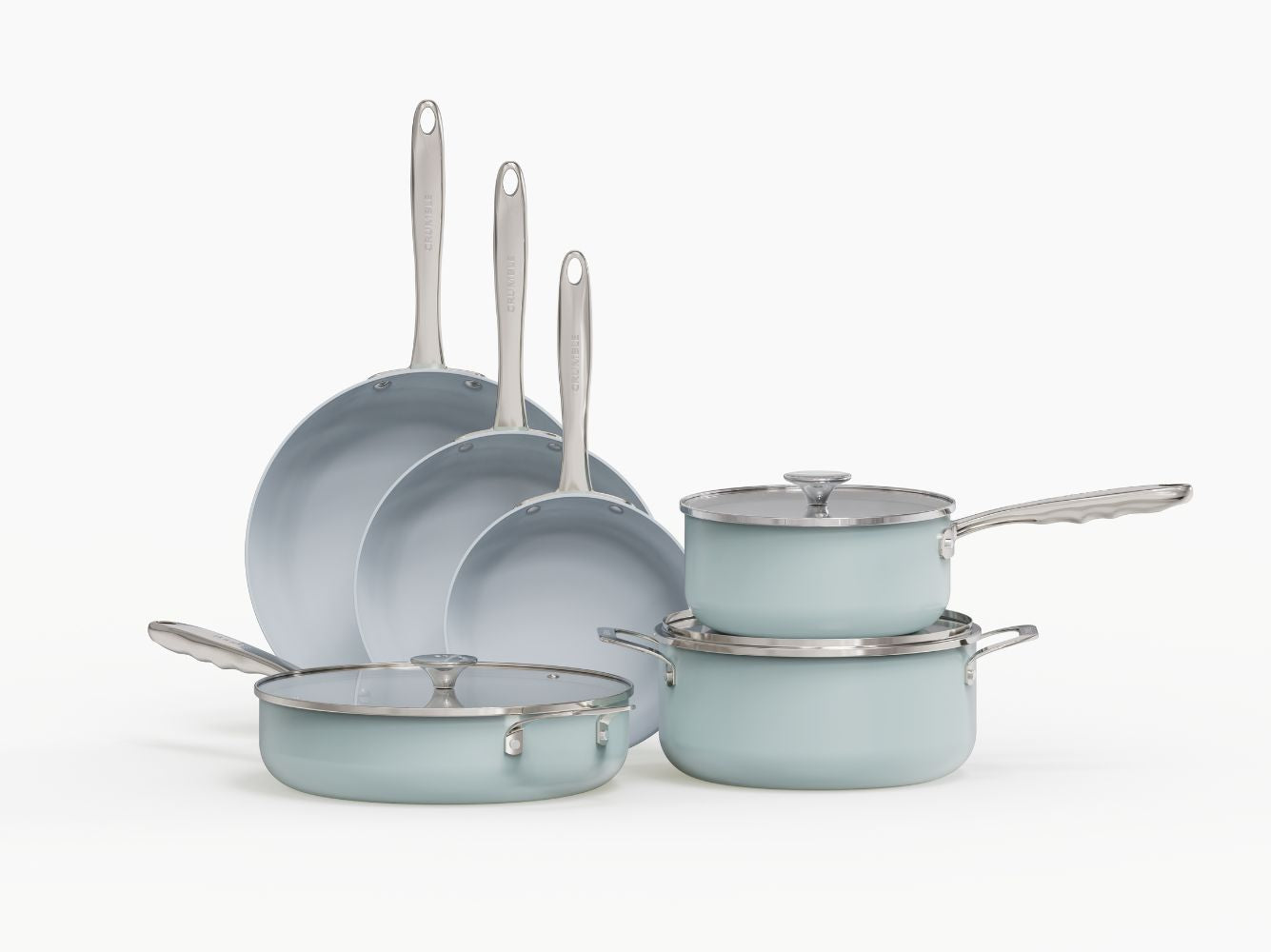
You’ve seen them. Those glossy, vibrant Dutch ovens sitting on a stove like a piece of jewelry in a high-end kitchen. Honestly, they’re hard to miss. While your grandma’s jet-black Griswold skillet is a legend in its own right, colored cast iron cookware—more technically known as enameled cast iron—has basically taken over the modern kitchen. It’s not just about the aesthetics, though the "Le Creuset look" is a whole vibe. There’s a lot of science, and a fair amount of marketing fluff, to wade through before you drop three hundred bucks on a pot.
Most people think the color is just a coating. It’s not. It’s actually a layer of glass. Specifically, it’s vitreous enamel, which is melted onto the iron at temperatures that would make a dragon sweat. This creates a surface that is totally non-reactive. You can’t cook a slow-simmered tomato sauce in raw cast iron without it tasting like a bag of pennies. With the enameled stuff? No problem. The acid doesn't touch the metal.
The Chemistry of Why People Obsess Over These Pots
Let’s get into the nitty-gritty of why this material behaves differently. Raw cast iron is porous. It needs oil to fill those pores, which we call "seasoning." Enameled colored cast iron cookware doesn’t need any of that. The enamel creates a barrier. It’s smooth. It’s impervious.
But here’s the trade-off. Glass is brittle.
I’ve seen people take a beautiful, flame-orange pot and toss it into a sink of cold water right after taking it out of a 450-degree oven. Crack. That’s called thermal shock. The iron and the enamel expand and contract at slightly different rates. If you move too fast, the glass literally shatters off the metal. It’s heart-breaking. You’re left with a very expensive boat anchor.
The heat retention is the real hero here, though. Cast iron is a poor conductor but a great radiator. It takes forever to get hot, but once it’s there, it stays there. This is why your braised short ribs come out so tender. The heat is steady. It’s predictable. Unlike stainless steel, which spikes and drops, enameled iron provides a "thermal mass" that keeps your stew bubbling at a consistent temperature even if you’re messing with the burner.
Brand Wars: Le Creuset vs. Staub vs. The Rest
If you’re shopping, you’ll notice two giants.
Le Creuset is the one everyone knows. They’ve been at it since 1925 in Fresnoy-le-Grand, France. Their stuff is lighter. The interiors are usually a sand-colored cream. This is actually a huge functional benefit. You can see the "fond"—those little brown bits of caramelized meat—at the bottom of the pot. If the bottom is black, you can’t tell if you’re searing or burning.
Then there’s Staub.
Staub goes the other way. Their interiors are matte black. It’s still enamel, but it’s textured. Fans of Staub, including many professional chefs, swear it browning meat better because of that texture. They also have those little spikes under the lid. Those are for "self-basting." Steam hits the spikes, condenses, and drips back down evenly onto the roast. It’s clever. Is it life-changing? Maybe not, but it’s a cool bit of engineering.
You also have the budget players like Lodge or various store brands. They work. They really do. However, the enamel on a $50 pot is usually thinner and more prone to "crazing"—those tiny spiderweb cracks—than the enamel on a $400 heirloom piece. You get what you pay for in terms of durability.
Stop Believing These Cookware Myths
Let’s kill a few myths right now.
First: "Enameled cast iron is non-stick."
No. It’s absolutely not. If you try to fry an egg in a brand-new enameled skillet without enough fat, you’re going to be scrubbing for an hour. It’s "stick-resistant" at best. You still need oil. You still need proper heat management.
Second: "You can use metal spoons."
Technically, you can. But you shouldn't. Metal leaves "silver" marks on the enamel. It doesn't always scratch the glass, but it leaves metal transfer that looks like scratches. Use wood or silicone. Keep it pretty.
Third: "It’s dishwasher safe."
The boxes often say it is. The reality? The harsh detergents in a dishwasher will eventually dull that beautiful glossy finish. It’ll go from a shiny Ferrari-red to a dull, matte pink over five years of dishwashing. Hand wash it. It’s not that hard.
Cooking Performance and Health
Some folks worry about the chemicals in the glaze. In the old days, some glazes used lead or cadmium to get those bright reds and yellows. Nowadays, reputable brands are strictly regulated. California’s Proposition 65 basically made sure that any colored cast iron cookware sold in the US has to meet incredibly high safety standards. If you’re buying a weird, unbranded pot from a random flea market? Maybe worry. If it’s a known brand? You’re fine.
In fact, enameled iron is one of the "cleanest" ways to cook. There’s no PFOA or PTFE like you find in traditional non-stick pans. It’s just iron and glass. It’s inert.
The Weird Reason Your Food Tastes Better
It’s the lid.
Most enameled Dutch ovens have heavy, tight-fitting lids. When you’re braising, you want to keep the moisture inside. A cheap aluminum pot lets steam escape. A heavy cast iron lid creates a pressurized-adjacent environment. The moisture stays in the meat. This is why you can take a tough-as-leather chuck roast and turn it into something you can eat with a spoon after three hours in a 300-degree oven.
Also, consider the "oven-to-table" factor.
Standard cast iron looks rugged and cool, but a bright cobalt blue enameled pot looks elegant on a dinner table. It holds heat so well that the food stays hot for the entire meal. It’s functional decor.
Maintenance Hacks That Actually Work
If you’ve stained the inside of your pot—maybe you burned some sugar or did a long red wine braise—don't reach for the steel wool. You'll ruin the finish.
Instead, use Bar Keepers Friend. Or, even simpler, boil some water with a healthy amount of baking soda. Let it soak. The stains usually lift right off. For the really stubborn "burnt-on" gunk, a paste of baking soda and a bit of dish soap left overnight does wonders.
Wait.
Before you go buying a whole set, listen: you don't need a whole set. You need one 5.5-quart round Dutch oven. That’s the "Goldilocks" size. It fits a whole chicken, a batch of soup, or a loaf of sourdough bread. Most people buy the giant 7 or 9-quart versions and then realize they can't actually lift them when they're full of food. Cast iron is heavy. A 7-quart pot full of chili can weigh 20 pounds. Your wrists will thank you for sticking to the 5.5.
Actionable Steps for Your Next Kitchen Upgrade
If you're ready to dive into the world of colored cast iron cookware, don't just grab the first pretty color you see at the mall.
- Check the weight. Pick it up. If it feels flimsy, the iron is thin, and it won't hold heat evenly. It should feel substantial.
- Inspect the rim. The rim is usually where the enamel is thinnest. Look for chips or "pinholes" (tiny bubbles in the glass). These are weak points.
- Think about the knobs. Some brands use phenolic (plastic) knobs that are only rated to 375°F. If you want to bake bread at 450°F, you’ll need to buy a separate stainless steel knob. High-end brands usually include the metal knob now, but check the box.
- Choose your color wisely. Trendy colors like "Peach Fuzz" might look great now, but will you like them in ten years? Classic colors like deep red, navy, or cream tend to have better resale value and timeless appeal.
- Test the lid fit. In the store, put the lid on and see if it wobbles. A little wiggle is normal, but it shouldn't be like a see-saw. You want that seal to be as tight as possible.
Stop treating these pots like museum pieces. They are workhorses. They are meant to be used, stained, and lived in. A chipped pot has character, though a chip on the inside cooking surface means it's time to retire it to a decorative planter role (glass shards in your food are a bad time).
Invest in one good piece. Learn how it holds heat. Experiment with a long braise. Once you see how much easier it is to clean than raw iron, and how much better it handles acid than stainless steel, you'll probably wonder why you waited so long to add some color to your kitchen.