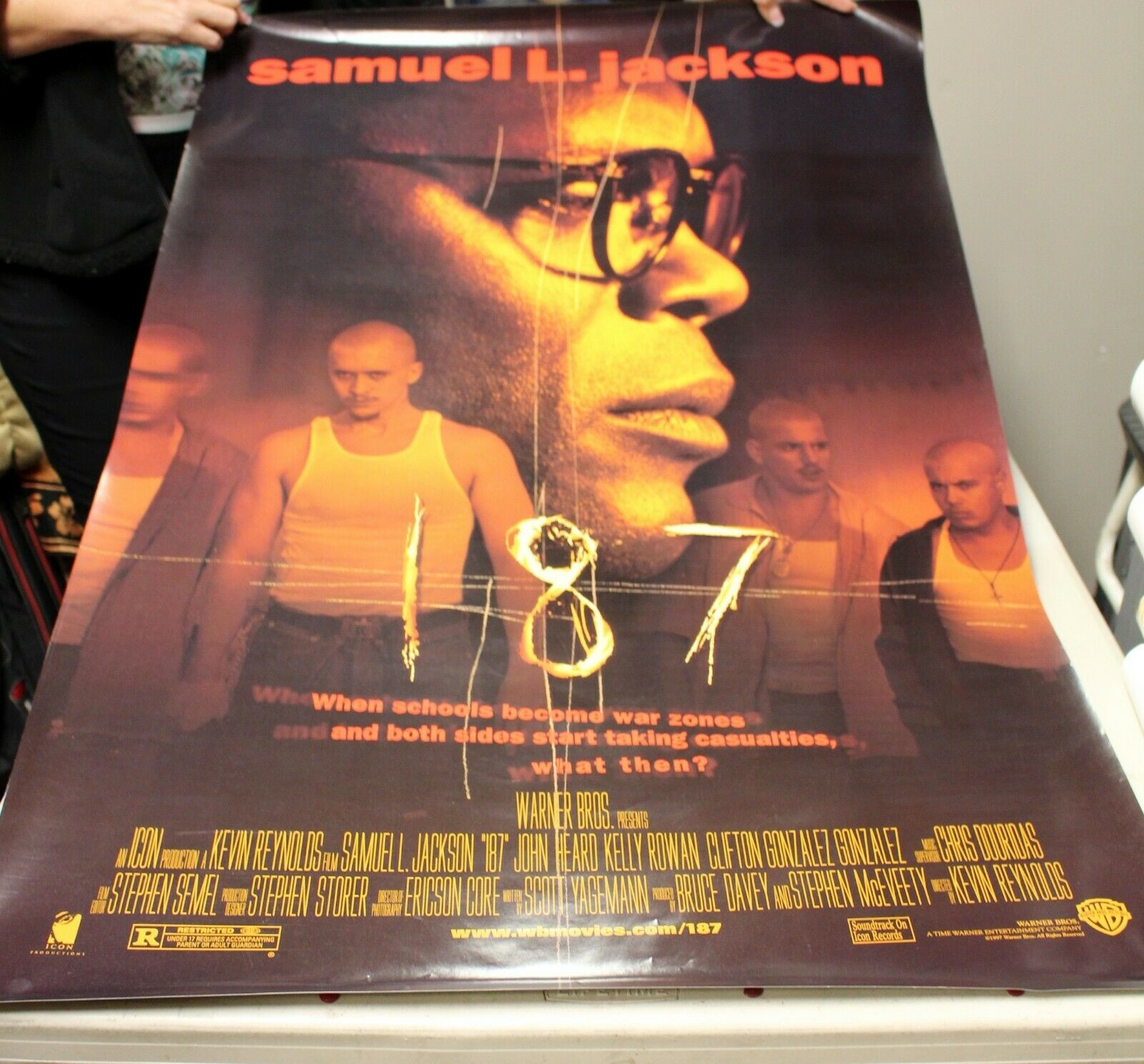
It is 1997. Samuel L. Jackson is essentially the coolest human being on the planet. He’s fresh off the explosive success of Pulp Fiction, he’s battled terrorists in a Die Hard sequel, and he’s about to become a Jedi. Then he makes a movie called One Eight Seven. It’s bleak. It’s sweaty. It’s uncomfortable in a way that 90s studio movies rarely dared to be. While most people remember him for shouting about snakes or "path of the righteous man" monologues, this specific film captures a version of Jackson that is quiet, broken, and terrifyingly real.
Most people don't talk about it anymore. That's a mistake.
The movie, often stylized as 187, refers to the California penal code for murder. It’s not just a clever title; it’s a warning. Jackson plays Trevor Garfield, a high school teacher in Brooklyn who gets stabbed in the back by a student after the administration fails to take a death threat seriously. He survives, moves to Los Angeles, and tries to start over. But he finds the same rot, the same apathy, and the same looming violence in the LA public school system. This isn't Dangerous Minds. Nobody is winning a dance contest or finding salvation through poetry here. It’s much darker.
The Brutal Realism of One Eight Seven
Hollywood loves a "savior teacher" narrative. You know the one—the middle-class hero walks into a "tough" school, wins over the kids with a bit of sass and a few rap lyrics, and everyone goes to college. One Eight Seven looks at that trope and sets it on fire. The script was written by Scott Yagemann, who actually spent seven years as a substitute teacher in Los Angeles. You can feel that lived-in frustration in every frame.
Garfield isn't a saint. By the time he reaches LA, he’s a man suffering from profound PTSD. He’s twitchy. He’s observant in a way that feels like a soldier in a bunker rather than a mentor in a classroom. When he encounters Cesar (played with chilling intensity by Clifton Collins Jr., then credited as Clifton Gonzalez Gonzalez), the film stops being a school drama and turns into a psychological thriller.
The cinematography by Ericson Core is worth mentioning because it looks like a fever dream. Everything is saturated in sickly oranges, deep shadows, and high-contrast yellows. It feels hot. You can almost smell the asphalt and the stale air of a classroom with broken air conditioning. It makes the viewer feel as agitated as the characters.
Why Samuel L. Jackson Chose This Role
Jackson has always been a workhorse, but in the late 90s, he was looking to prove his range beyond the "cool guy with a gun" archetype. In an interview with The Morning Call back during the film's release, he noted that he wanted to play someone who was "vulnerable."
Think about that. Vulnerability isn't a word we usually associate with the man who played Nick Fury.
In One Eight Seven, he spends a lot of time just reacting. He watches his students with a mixture of pity and genuine fear. There is a scene where he’s sitting in his apartment, alone, dealing with the physical scars on his back, and you see the toll that "caring" has taken on him. It’s a quiet performance that eventually boils over into something chaotic.
It’s also a movie that tackles the "model minority" myth and racial tensions within the school system in a way that was way ahead of its time. Garfield is a Black man who is being victimized by his own students, some of whom are Black and many of whom are Latino. The film refuses to provide easy answers about systemic failure. It basically says the system is a meat grinder and everyone is getting chewed up.
The Controversial Russian Roulette Scene
You can't discuss One Eight Seven without talking about the ending. It is, quite frankly, one of the most stressful things ever put to celluloid. Without spoiling the entire sequence for those who haven't seen it, the film culminates in a game of Russian Roulette that serves as a metaphor for the entire education system: a literal gamble with the lives of young men.
Critics at the time were divided. Some, like Roger Ebert, gave it a lukewarm review, suggesting the film leaned too hard into melodrama toward the end. Others felt it was a brave, if nihilistic, look at a broken society. Honestly? Both can be true. It’s a movie that takes big swings. It doesn't always land them gracefully, but it never feels fake.
Comparing 187 to Other Teacher Movies
To understand why this film stands out, you have to look at what else was out there.
- Stand and Deliver (1988): High hope, high achievement, based on a true success story.
- The Substitute (1996): An action movie where a mercenary goes undercover as a teacher. Pure fantasy.
- One Eight Seven (1997): A psychological horror story about burnout and the loss of one's soul.
While The Substitute was fun in a "turn your brain off" kind of way, One Eight Seven demands that you keep your brain on and your stomach tight. It asks what happens when the "good guy" stops believing in the "good."
The film also features a young Method Man and a very early performance from Kelly Rowan. The supporting cast helps ground the film in a reality that feels uncomfortably close to the nightly news of that era. It arrived during a period of high anxiety about urban violence and "super-predator" rhetoric, yet it manages to humanize the students even as it shows them doing terrible things. They are products of their environment, sure, but the film doesn't let them—or the adults—off the hook.
A Technical Masterclass in Mood
Director Kevin Reynolds, known for Robin Hood: Prince of Thieves and Waterworld, was an interesting choice for this. He brought a sense of scale and visual flair to what could have been a very small, stagey movie. The way he uses the camera to track Garfield through the hallways makes the school feel like a labyrinth.
The sound design is equally oppressive. There’s a constant low hum, the sound of distant sirens, and the jarring noise of school bells that sound more like prison alarms. It builds a sense of dread that never really lets up. Even when Garfield is "safe" at home, he isn't. The city is always bleeding in through the windows.
The Legacy of 187 in the 21st Century
Rewatching One Eight Seven today is a surreal experience. Some aspects feel like a time capsule of the late 90s—the fashion, the baggy jeans, the specific slang. But the core themes? They haven't aged a day. We are still debating school safety, teacher burnout, and the failure of the "zero tolerance" policies that the film critiques.
It’s also a reminder of what we’ve lost in modern cinema. We don't get many mid-budget, R-rated social thrillers anymore. Everything now is either a massive blockbuster or a tiny indie film. One Eight Seven was a major studio release (Warner Bros.) that dared to be relentlessly depressing and morally ambiguous.
If you're a fan of Samuel L. Jackson, you owe it to yourself to track this down. It’s easily one of his top five performances. He isn't the hero we want; he's the victim we're afraid of becoming. He shows us the cost of empathy in a world that doesn't value it.
How to Revisit the Film
If you're looking to watch or study the film, don't expect a feel-good experience. It’s a "tough watch" for a reason.
- Watch the eyes: Pay attention to Jackson’s eyes in the first act versus the third act. The "light" going out is a masterclass in subtle acting.
- Listen to the score: The trip-hop influenced soundtrack by Method Man and others perfectly captures the urban anxiety of the era.
- Research the writer: Look up Scott Yagemann’s interviews about his time as a sub. It adds a layer of terrifying validity to the more "extreme" scenes in the movie.
- Look for the symbolism: The use of the "187" tag throughout the film isn't just graffiti; it's a recurring ghost that haunts Garfield.
The movie isn't perfect. It’s messy and sometimes leans into its own nihilism a bit too hard. But it’s honest. In a world of focus-grouped endings and sanitized heroes, there is something deeply refreshing about a movie that is willing to be this angry.
If you want to see a different side of a Hollywood icon, go find a copy of One Eight Seven. It’s a reminder that before he was an Avenger, Samuel L. Jackson was one of the most fearless dramatic actors in the business. Just don't expect to feel okay when the credits roll.
To truly appreciate the film's impact, compare it to contemporary social dramas. You’ll find that while technology has changed, the underlying tensions Jackson portrays are still very much part of the American fabric. Analyzing the film’s use of color and sound can also provide a deeper understanding of how directors manipulate mood to reflect a character’s declining mental state. Seeking out the original theatrical trailer versus the final product also reveals how the studio struggled to market such a grim, uncompromising vision to a 1997 audience.