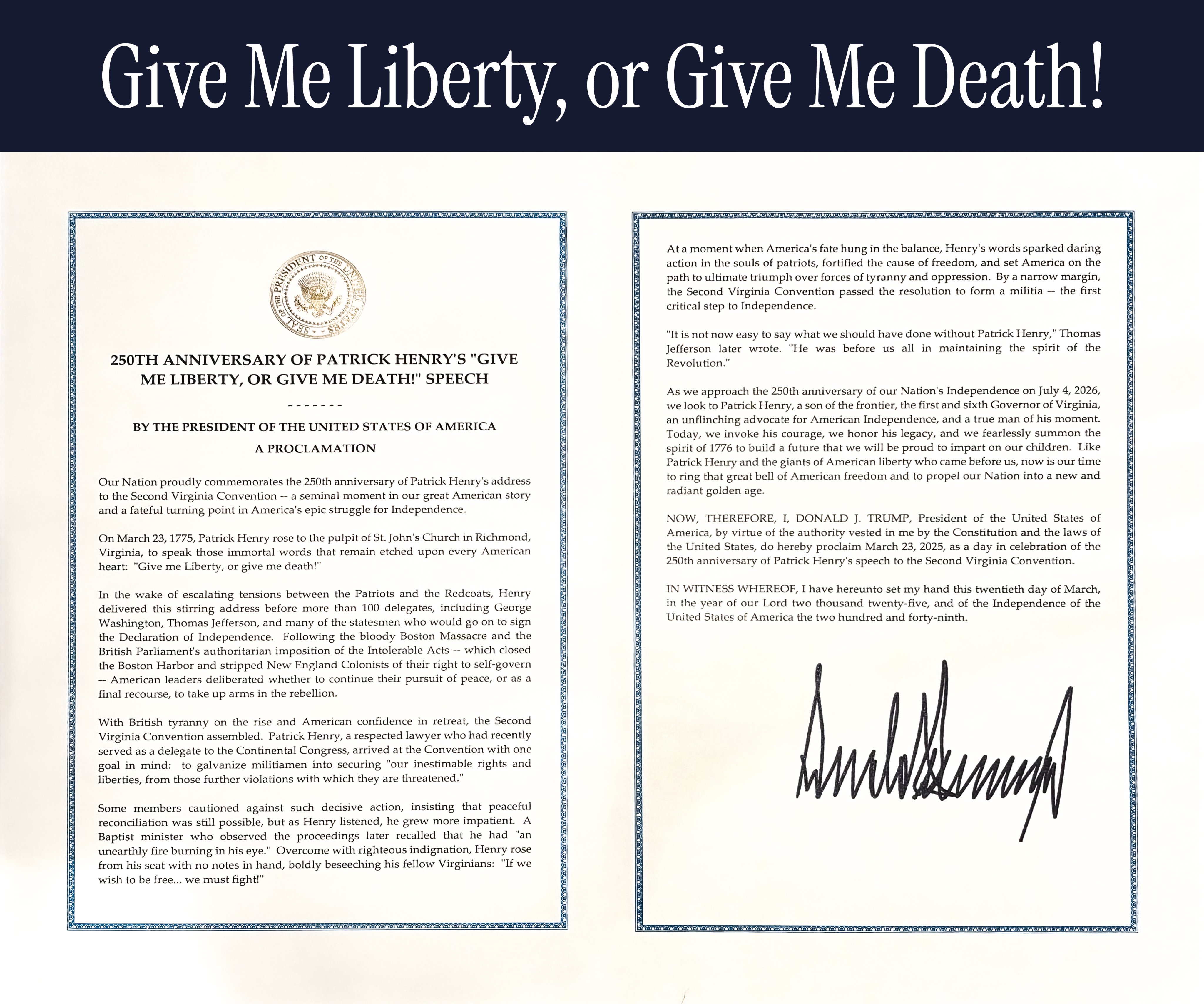
March 23, 1775. A cold, rainy day in Richmond, Virginia. You’ve got to picture the scene at St. John’s Church because it wasn’t some grand, marble-pillared hall. It was a wooden building, smelling of damp wool and candle wax, packed with men who were technically committing treason just by being there. This is where Patrick Henry stood up and delivered the give me liberty or give me death speech, a moment that basically set the fuse for the American Revolution.
Most people think this was a polished, pre-written address. It wasn't. Henry didn't have a teleprompter or a stack of legal pads. He was a lawyer by trade, a guy known for being a bit of a firebrand, and he was speaking entirely off the cuff. Honestly, we don't even have a "perfect" transcript of what he said that day. What we read in history books now was actually reconstructed decades later by a biographer named William Wirt, who interviewed people who were in the room. Even so, the vibe—the raw, desperate energy—remains one of the most powerful examples of rhetoric in human history.
What Really Happened During the Give Me Liberty or Give Me Death Speech
The Second Virginia Convention was a high-stakes poker game. The delegates were arguing about whether to form a local militia to defend against the British. Some guys—the moderates—wanted to wait and see. They thought King George III might still listen to reason. They were wrong, obviously, but you can’t blame them for being scared. If they fought and lost, they’d all end up at the end of a rope.
Then Henry gets up. He starts out polite, which is a classic rhetorical move. He acknowledges the "patriotism" of the guys who just spoke against him. But then he flips the switch. He tells them that the time for "hope" is over. He points out that the British are already sending fleets and armies. "Are fleets and armies necessary to a work of love and reconciliation?" he asks. It’s a sarcastic, biting question. He’s calling out the cognitive dissonance of his colleagues.
He didn't just speak; he performed. Witnesses said that when he reached the climax of the give me liberty or give me death speech, he actually leaned forward with his wrists crossed, as if they were bound in invisible chains. Then, at the very end, he mimed plunging a letter opener into his chest. It was theater. It was punk rock for the 18th century.
Why the Context of 1775 Matters More Than the Words
If you just read the text, it’s great, but you miss the life-or-death stakes. Virginia was the wealthiest and most populous colony. If Virginia didn't move, the Revolution was likely dead in the water. Henry wasn't just talking to the room; he was talking to the fence-sitters across all thirteen colonies.
The British had already closed the port of Boston. The Intolerable Acts were in full swing. Henry’s argument was basically: "Look, they're already treating us like slaves. We are already at war; we just haven't admitted it yet." He used the word "slavery" a lot. Now, looking back with 21st-century eyes, there’s a massive, glaring irony there. Many of the men in that room, including Henry himself, were enslavers. They were demanding liberty from a king while holding people in actual, literal bondage. It’s a messy, uncomfortable contradiction that historians like Alfred F. Young and others have pointed out for years. You can't talk about the "liberty" Henry demanded without acknowledging the people he denied it to. That doesn't make the speech less influential, but it does make it more complex than the "heroic" version taught in third grade.
The Power of the "Give Me Liberty or Give Me Death Speech" Rhetoric
What makes this work so well? It’s the "either-or" fallacy, but used for good. He creates a binary. There is no middle ground. You are either a hero or a coward. You are either free or a slave. In a crisis, people crave that kind of clarity.
- He uses rhetorical questions to make the audience feel like they’ve come to the conclusion themselves.
- He uses religious imagery. He talks about "the God of hosts" and "holy cause of liberty." In a room full of Anglicans, that's how you win hearts.
- The pacing. It starts slow and builds into a rhythmic, pounding crescendo.
It worked. The convention passed the resolution to put Virginia into a "state of defense." A few weeks later, the "shot heard 'round the world" was fired at Lexington and Concord. Henry didn't start the war, but he made sure Virginia was ready to finish it.
Common Misconceptions About the Speech
People think everyone loved it. Not true. Some people in the room were absolutely horrified. They thought he was a madman. Others thought he was a dangerous radical who was going to get them all killed. We have letters from people who were there saying they were "struck with a sort of horror" by his intensity.
Another big misconception is that the version we read today is 100% what he said. As I mentioned, William Wirt wrote the "definitive" version in 1817. He had to rely on the memories of elderly men who had heard the speech 40 years prior. Think about it. Can you remember exactly what someone said in a meeting 40 years ago? Probably not. You’d remember the main points and how it made you feel. So, the text we have is likely a "greatest hits" version of the actual give me liberty or give me death speech.
The Lasting Legacy in Modern Culture
Why do we still care? Because the central theme—that some things are more important than life itself—is universal. We see echoes of this speech in every protest movement, every war for independence, and even in modern political stump speeches. It’s the ultimate "line in the sand" moment.
In 2026, looking back at a speech from 1775 might feel like looking at ancient history. But the core tension—security vs. freedom—is something we’re still fighting about today. Whether it’s data privacy, government overreach, or international conflicts, we are constantly asking ourselves: "What am I willing to sacrifice for my autonomy?" Henry’s answer was everything.
If you want to understand the American character, you sort of have to start here. It’s loud, it’s a bit dramatic, it’s deeply flawed, and it’s incredibly effective. It’s not just a speech; it’s an artifact of a moment when a group of people decided to jump off a cliff and hope they could fly.
Practical Steps for History Buffs
If you actually want to "feel" this history instead of just reading a Wikipedia page, there are a few things you should actually do.
First, go to Richmond. St. John's Church still stands. They do reenactments of the speech during the summer months. Standing in the spot where the pews were packed with guys like Thomas Jefferson and George Washington changes how you hear the words.
Second, read the 1817 biography by William Wirt. It’s flowery and over-the-top, but it captures the romanticism of the early 19th century and how they viewed the Founders. It tells you a lot about how the American "myth" was constructed.
Third, look at the "Virginia Resolutions" that the speech was supporting. Seeing the legal language helps you understand that this wasn't just a guy shouting; it was a legislative maneuver designed to prepare for a war that everyone knew was coming.
Finally, compare the give me liberty or give me death speech to other famous speeches from the era. Read it alongside the Declaration of Independence. You’ll see that while Jefferson was the "pen" of the Revolution, Henry was the "voice." One provided the logic; the other provided the adrenaline.
Essential Actionable Insights
- Visit the Source: Head to St. John’s Church in Richmond, Virginia, to see the "Give Me Liberty" reenactments. They are historically accurate in terms of costume and setting.
- Analyze the Rhetoric: If you’re a public speaker, study Henry’s use of the "rule of three" and his tactical use of pauses. It’s a masterclass in emotional persuasion.
- Fact-Check the Text: Remember that the version we have is a reconstruction. When citing the speech, acknowledge it was recorded by William Wirt years after the fact to show true historical literacy.
- Contextualize: Read up on the "Gunpowder Incident" that happened shortly after the speech. It shows just how fast things moved from words to actual weapons.