The year was 2003. Bravo wasn’t yet the 24/7 Housewife-industrial complex it is today. Into this mid-tier cable landscape dropped a show with a title so provocative for the time that it felt like a dare: Queer Eye for the Straight Guy. People forget how radical it felt. Honestly, the premise was simple enough—five gay men (The Fab Five) gave a makeover to a "helpless" straight man—but the cultural ripple effect was massive. It wasn't just about hair gel or throw pillows. It was about masculinity, which, at the turn of the millennium, was in a bit of a crisis.
It worked.
The original Fab Five—Ted Allen, Kyan Douglas, Thom Filicia, Carson Kressley, and Jai Rodriguez—became overnight icons. They didn't just fix closets; they challenged the idea that caring about your appearance or your home was somehow "unmanly." Suddenly, the "metrosexual" was a household term. Looking back, the show was a fascinating, often messy, artifact of early 2000s liberalism. It was the first time many Americans invited gay men into their living rooms, even if it was through a television screen.
The Fab Five and the Architecture of the Makeover
You can't talk about Queer Eye for the Straight Guy without breaking down the specific roles that made the machine hum. David Collins, the creator, hit gold with this casting. Each guy had a lane. Ted Allen was the food and wine expert, essentially the sophisticated older brother. Kyan Douglas handled grooming, Thom Filicia did interior design, Carson Kressley was the high-energy fashion maven, and Jai Rodriguez focused on "culture."
The "culture" bit was always the hardest to define. Usually, it meant teaching a guy how to talk to his wife or how to properly introduce himself at a party. It was sort of like social etiquette for the modern man.
The structure was predictable but addictive. They’d storm a messy apartment, roast the guy's wardrobe (Carson's "Get out!" was a catchphrase for a reason), and then spend a week transforming his life. It culminated in a big event—a proposal, a gallery opening, a dinner party—where the "hero" had to fly solo. Watching the Fab Five watch the hero on a grainy monitor, cheering like proud parents, was the secret sauce. It was genuine. It gave the show a heart that outweighed the snark.
Why the "Metrosexual" Trend Exploded
Before this show, the average American guy’s grooming routine was basically a bar of Irish Spring and a prayer. Queer Eye for the Straight Guy changed the retail economy. Sales of male grooming products skyrocketed. Marketers realized that straight men were a massive, untapped market for moisturizers, premium denim, and high-end cookware.
It’s easy to dismiss it as consumerism. But it also broke down some pretty rigid walls.
The show suggested that vulnerability was okay. It argued that a man could care about the thread count of his sheets without losing his "man card." Of course, by today's standards, some of the humor feels dated. There was a lot of playing into stereotypes to make the "gay-to-straight" interaction palatable for a 2003 audience. The show often framed the Fab Five as magical helpers whose only purpose was to improve the lives of straight people. This is a trope many queer theorists have critiqued since. But at the time? It was a bridge.
Behind the Scenes: The Reality of the "Reality"
If you talk to anyone who worked on the set at Chelsea Piers, they’ll tell you the schedule was grueling. This wasn't a "fake" makeover in the sense that the work didn't happen. The renovations were real. The haircuts were real. However, the "one-week" timeline was often a miracle of production editing and frantic late-night labor.
Thom Filicia once mentioned in interviews that they weren't just decorating; they were often doing minor construction in record time.
The show eventually won an Emmy for Outstanding Reality Program in 2004. Its success led to international versions in the UK, Australia, and Germany. But by 2007, the buzz had faded. The culture had moved on—partly because the show had been too successful. The "straight guy" had been educated. The novelty of seeing gay men on TV had started to normalize, which was exactly the point.
Comparing the Original to the Netflix Reboot
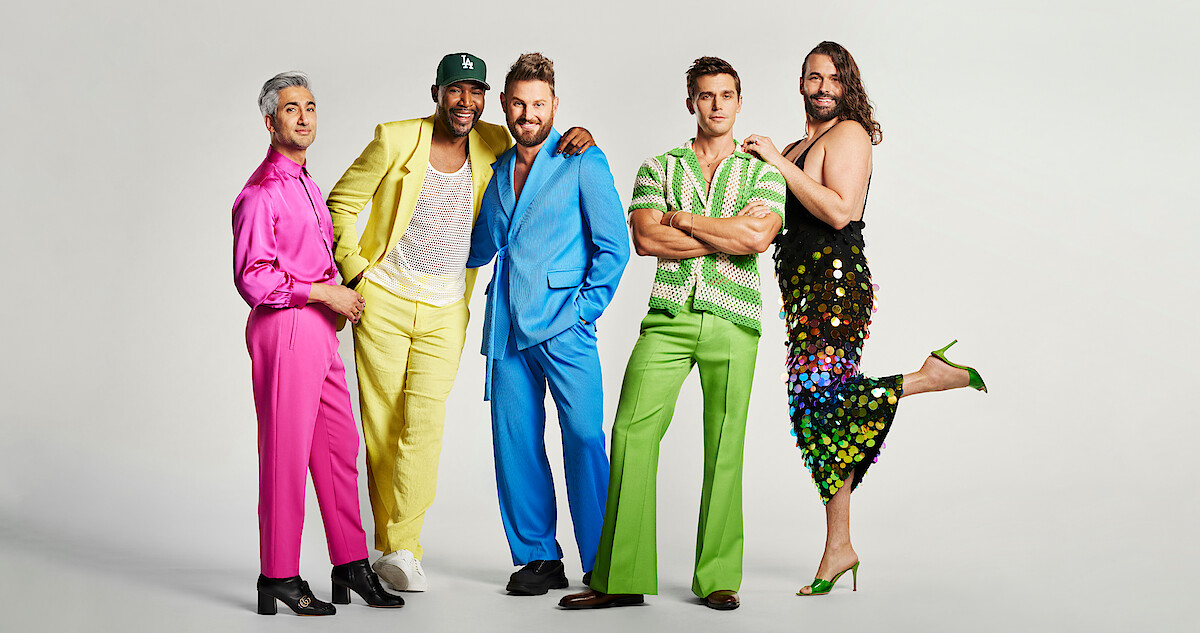
In 2018, Netflix revived the brand, dropping the "for the Straight Guy" suffix. The new Fab Five—Antoni Porowski, Tan France, Karamo Brown, Bobby Berk, and Jonathan Van Ness—took the foundation and modernized it.
There are some massive differences:
- Location: The original was firmly rooted in New York City. The reboot travels to the South, the Midwest, and even Japan, tackling much deeper cultural divides.
- Depth: While the 2003 version was often about "fixing" someone, the Netflix version is more about "healing" someone.
- The Subjects: The reboot includes women, trans men, and queer heroes. It’s no longer just about the straight man’s plight.
- Self-Care vs. Grooming: Jonathan Van Ness talks about self-love in a way that Kyan Douglas, constrained by 2003 TV norms, rarely could.
The original show was a product of its time—flashy, snappy, and a bit superficial. The reboot is a product of our time—empathetic, politically conscious, and highly emotional. You can't have the latter without the former. The 2003 series did the heavy lifting of breaking the ice.
The Financial Impact of the Queer Eye Effect
The business side of this show is wild. It wasn't just a TV hit; it was a massive marketing vehicle. Product placement was baked into the DNA. If Ted Allen used a specific chef's knife, that knife sold out. If Carson mentioned a brand of shoes, that brand saw a spike.
It proved that "lifestyle" content for men was a goldmine. This paved the way for everything from GQ's digital dominance to the rise of male influencers on Instagram and TikTok. We take it for granted now that men care about "skincare routines," but in 2003, that was a punchline. The Fab Five turned it into a lifestyle.
Lessons from the Original Fab Five
There’s a reason people still go back and watch the old clips. There was a specific chemistry between the original five that is hard to replicate. They were genuinely friends, and their banter wasn't scripted by a room of 22-year-old interns. They knew their stuff. Ted Allen wasn't just a "food guy"; he was a legitimate editor at Esquire. Thom Filicia was an established interior designer. This expertise gave the show authority.
When they told a guy his rug was hideous, they weren't just being mean. They were right.
What most people get wrong about the show is thinking it was just about vanity. It was actually about confidence. The "straight guy" usually felt stuck—in a job, in a relationship, or just in a rut. The makeover was a catalyst to get him moving again. That’s a universal human story, regardless of sexual orientation.
Practical Insights for the Modern Man
If you’re looking to apply the Queer Eye for the Straight Guy philosophy today, it doesn't mean you need to go out and buy a $2,000 suit. It’s simpler than that.
First, look at your environment. Your home should be a place that recharges you, not a place that stresses you out. Throw away the broken furniture. Buy a plant.
Second, grooming is non-negotiable hygiene, not a hobby. A good haircut and a basic skincare routine change how you carry yourself.
Third, and this was Jai’s department: show up. Be present in your relationships. Learn how to cook one "signature" meal that you can make for someone you love. The show taught us that "lifestyle" isn't about how much money you spend, but about the intentionality you bring to your daily life.
The original series eventually ended its run with a series of specials, but its DNA is everywhere. Every time you see a "makeover" segment on a morning show or a "glow up" video on YouTube, you’re seeing the ghost of 2003 Bravo. It changed the way we look at men, and more importantly, how men look at themselves.
To really level up your own "Queer Eye" journey, start with these steps:
- Audit your closet: If you haven't worn it in two years, donate it. Fit is more important than the brand name.
- Update one room: Focus on lighting. Replace harsh overhead "big lights" with lamps to create a better mood.
- Learn the basics of a kitchen: You don't need to be a chef, but knowing how to properly roast a chicken or toss a salad is a foundational life skill.
- Invest in a tailor: This was Carson Kressley’s biggest secret. Even cheap clothes look expensive if they actually fit your body.
The Fab Five might have moved on to other projects—Ted Allen is the face of Chopped, Carson is a judge on RuPaul’s Drag Race—but the lesson remains. A little bit of effort goes a long way. You don't need a TV crew to start caring about the details.