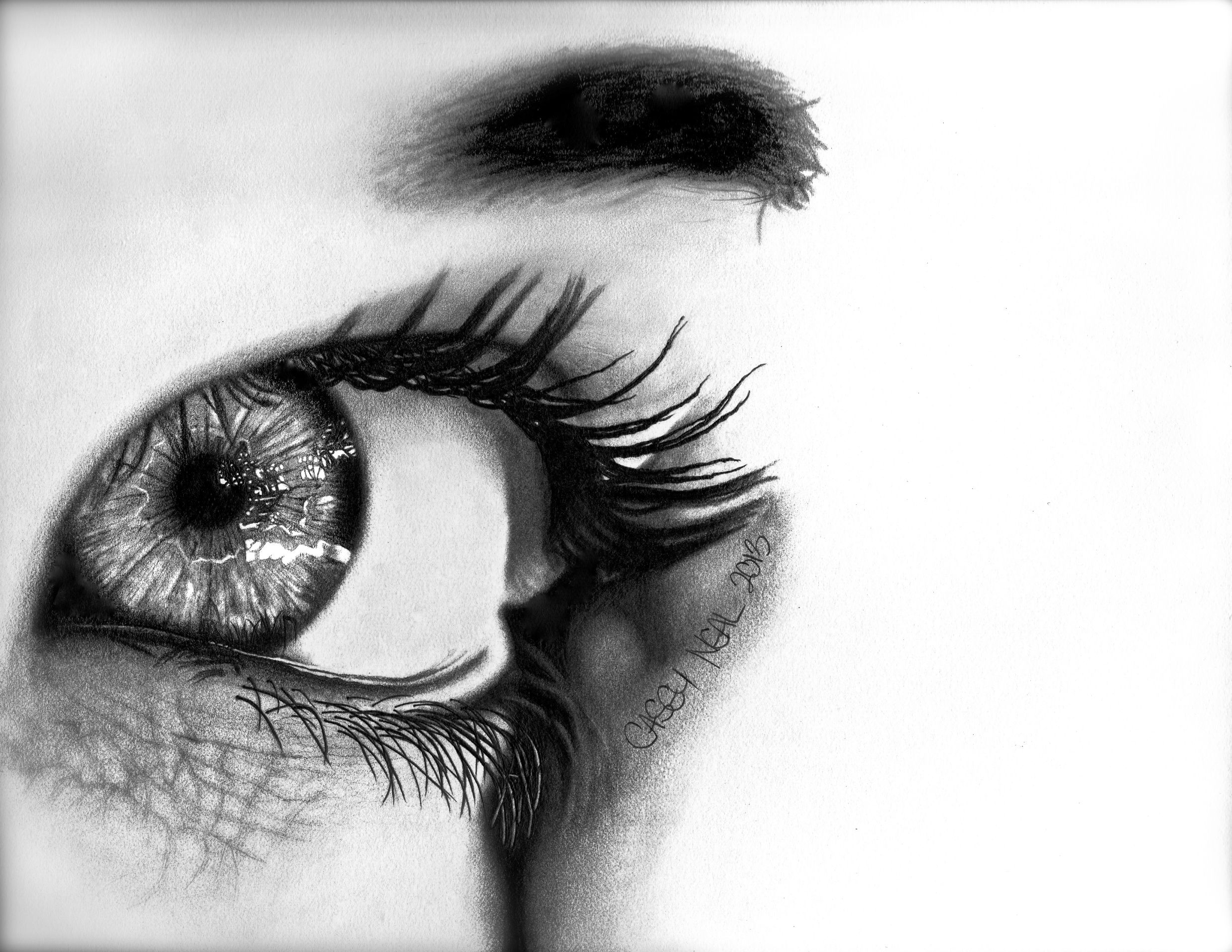
You’ve seen it. You’re scrolling through a high-end photography feed or maybe just looking really closely at a selfie, and there it is—a tiny, distorted world captured right on the surface of the cornea. Most people call it a "catchlight" when it’s just a white dot, but the actual reflection in an eye is a complex optical phenomenon that forensic experts, professional portrait photographers, and even AI developers obsess over. It's basically a curved mirror made of biological tissue.
Ever wonder why some eyes look "dead" in photos while others sparkle? It isn't just about the person's mood. It's physics.
The human eye is covered by the cornea, a transparent, highly vascularized layer that acts as the primary refractive element. Because it’s wet—thanks to the tear film—it is incredibly reflective. This film is only a few micrometers thick, yet it creates a convex mirror effect. When light hits it, it bounces back, carrying a miniaturized, wide-angle version of whatever is in front of the person. This is how we get those tiny "vibe" shots where you can see the photographer or the window in the subject's pupil. It’s kinda wild when you think about the sheer amount of data packed into a space smaller than a ladybug.
The science of the corneal reflection
To understand a reflection in an eye, you have to look at the Purkinje images. These are four distinct reflections that occur at different interfaces of the eye. The first one, often called P1, is the one we usually see. It’s the reflection off the outer surface of the cornea.
There are actually others. P2 reflects off the inner cornea, P3 off the front of the lens, and P4 off the back of the lens. P4 is weird because it’s inverted. If you’re a doctor using an ophthalmoscope, you’re looking at these to check if everything is aligned. If they aren't where they should be, it might indicate strabismus—basically, the eyes aren't looking in the same direction.
Photographers use this to their advantage. A "ring light" creates a circular reflection that looks futuristic. A "softbox" creates a window-like square. Without these reflections, eyes look flat. Almost like plastic. That’s because, in nature, a matte eye usually means the creature is dehydrated or, well, not alive. Our brains are hardwired to look for that glint. If it’s missing, we feel an instinctive sense of unease.
Forensic "Eye-Witnessing" and the Zoom-In Myth
We’ve all seen the crime shows. The detective shouts "Enhance!" and suddenly a grainy CCTV frame of a reflection in an eye reveals the killer’s face, their license plate, and what they had for lunch.
Is that real? Sorta. But mostly no.
In 2013, researchers Rob Jenkins and Christie Kerr at the University of York did a famous study on this. They took high-resolution photos and found that they could actually identify faces reflected in the eyes of the subject. They used a 39-megapixel camera. When they zoomed in on the corneal reflection, the "bystander" faces were only about 30 pixels wide. Despite the low resolution, participants could match those tiny, blurry blobs to familiar faces with 71% accuracy.
But here is the catch. You need incredible lighting and a massive sensor. Your average doorbell camera isn't going to show a reflection of a suspect in a victim's eye. The curvature of the eye also creates massive spherical aberration. The image is stretched. It’s distorted. It’s like looking at a funhouse mirror.
Why AI still struggles with the reflection in an eye
If you want to spot a fake AI image, look at the eyes. It’s one of the biggest "tells" left in generative models.
AI often gets the physics of light wrong. In a real photo of two people standing next to each other, the reflection in an eye for Person A should match the environment of Person B. More importantly, the reflection in the left eye should be consistent with the reflection in the right eye. AI frequently puts a window in the left eye and a lightbulb in the right eye. Or the reflection doesn't follow the curvature of the eyeball, looking like a flat sticker instead of a wrapped image.
Real light behaves according to the laws of specular reflection. The angle of incidence equals the angle of reflection. Because the eye is a sphere (roughly), the light hits different points at different angles. This causes the reflection to "shift" as the person moves their head. AI is getting better, but it still struggles with the microscopic consistency of the tear film's meniscus—the way the liquid pools at the bottom of the eyelid and catches a tiny, separate sliver of light.
Catchlights: The secret sauce of portraiture
If you’re taking a photo and the eyes look dull, you’re missing the light. You don't need fancy gear. You just need a source.
- The Window Light: Positioning someone 45 degrees from a window creates a large, soft reflection that fills the upper quadrant of the iris. It looks natural and "expensive."
- The Sun: Direct sunlight creates a tiny, piercing white dot. It’s high-contrast. It can look aggressive.
- The Reflector: If you’re outside, holding a white piece of paper just out of frame can "bounce" a reflection into the lower part of the eye, filling in shadows.
The position matters too. A reflection at "10 o'clock" or "2 o'clock" feels natural because it mimics the sun or overhead lights. A reflection coming from the bottom of the eye (6 o'clock) often looks "spooky" or "villainous" because it suggests light coming from the ground, like a campfire or a flashlight held under the chin.
Beyond the surface: What the iris does to light
It isn't just about the reflection on the surface. Light also passes through the cornea, through the pupil, and hits the lens. But some of it hits the iris.
The iris is a muscle. It’s also textured. When light hits a blue or green eye, it undergoes Tyndall scattering—the same reason the sky is blue. The reflection you see isn't just the "mirror" on top; it’s the interplay between the surface glint and the structural color of the tissue underneath. Darker eyes have more melanin, which absorbs more light, making the surface reflection in an eye stand out even more because there is less "backglow" from the iris itself.
Honestly, it’s one of the most beautiful accidents of human anatomy. We have these built-in mirrors that constantly broadcast our surroundings to anyone looking close enough.
Practical takeaways for better eye reflections
If you want to master this, whether for photography or just to understand what you're seeing, keep these points in mind:
- Check for symmetry. In a natural photo, the reflections in both eyes should be nearly identical in shape and position. If they aren't, the light source is very close or the image has been poorly edited.
- Look for the "depth." A real reflection sits on the cornea, which is slightly in front of the iris. This creates a sense of three-dimensional depth. If the reflection looks like it’s "on" the color of the eye, it’s a fake or a bad contact lens.
- Clean the "mirror." This sounds weird, but for photographers, having a subject blink right before a shot refreshes the tear film. This creates a smoother, sharper reflection because the "mirror" surface is perfectly wet.
- Mind the environment. If you are taking a secret photo (not that you should), remember that your phone’s screen is reflecting in your eye. Someone looking at your selfie can often see exactly what you were looking at on your screen if the brightness is up.
The next time you look at someone, don't just look at the color of their eyes. Look at the tiny world bounced off the surface. It’s a literal perspective on their reality, captured in a fraction of a millimeter of salt water and protein. It’s the kind of detail that makes a portrait feel like a person rather than just a picture.
To improve your own photos immediately, move your subject so they are facing toward a light source rather than having it behind them. Even a small lamp in the background can provide enough "ping" to make the eyes pop. For those interested in the forensic side, remember that while "enhancing" has limits, the biological "mirror" of the eye is a real data point used in high-level image authentication and biometric security today. Every glint is a map of the room. Every sparkle is a data point. Look closer.