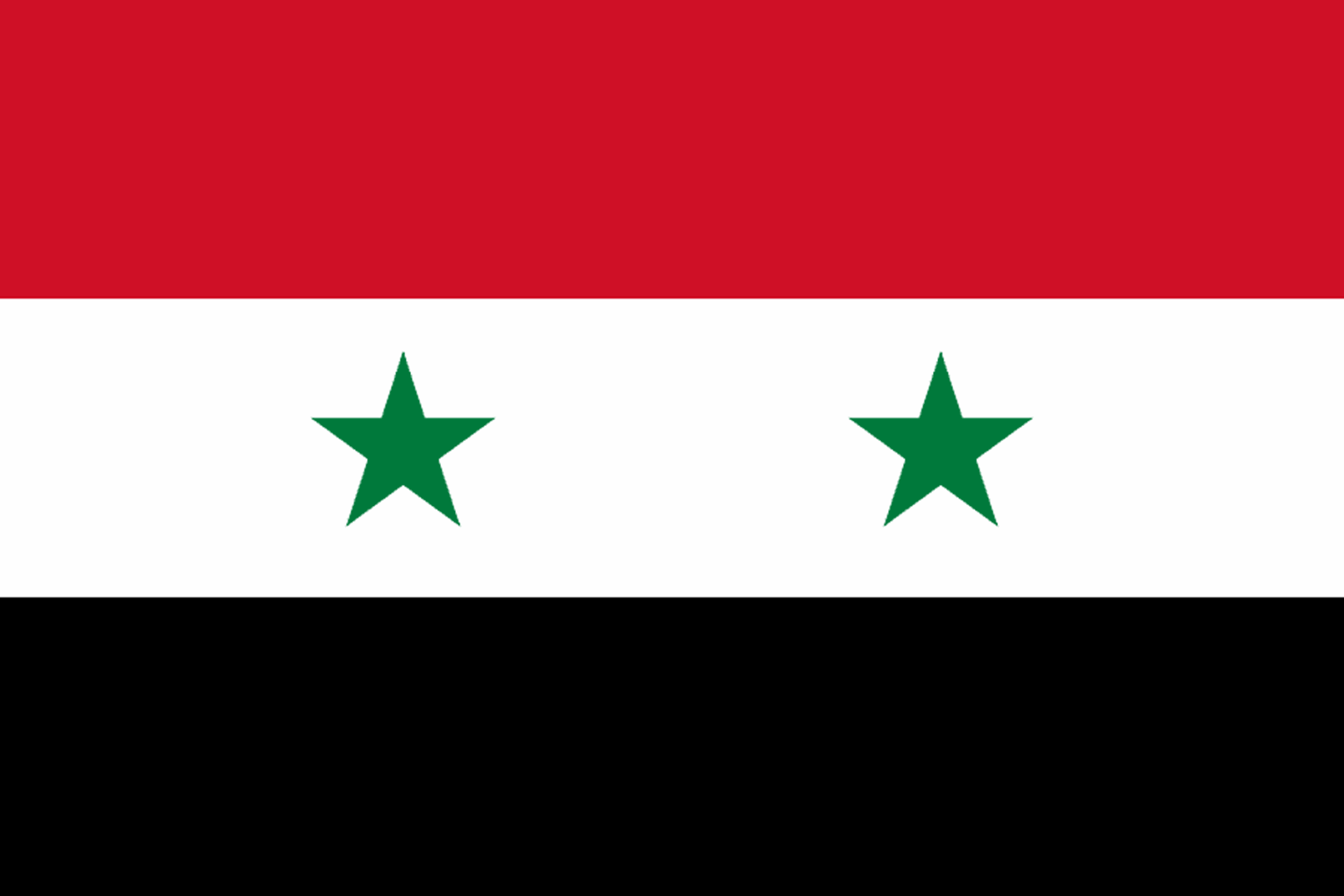
If you’ve been scrolling through the news lately, you might have noticed a sudden, jarring change in the videos coming out of Damascus. The red, white, and black flag that defined the Syrian state for decades has basically vanished overnight. In its place, a green, white, and black tricolor with three red stars is everywhere.
So, when did Syria change its flag?
The short answer is December 2024, following the collapse of Bashar al-Assad’s government. But that’s actually only the most recent chapter in a century-long game of musical chairs with national symbols. Honestly, Syria has changed its flag more times than almost any other modern nation.
The December 2024 Shift: Out With the Old
For over 40 years, the "two-star flag" (red top, black bottom, two green stars) was the only one you'd see on official buildings. It was the flag of the Ba'ath party era. But on December 8, 2024, as rebel forces entered the capital and the previous regime crumbled, that flag was physically torn down from embassies and government ministries.
By March 2025, a formal Constitutional Declaration made it official: the "Independence Flag"—the green-white-black one—is now the primary national banner. People often call it the "Revolution Flag" because it was the rallying cry for the opposition since 2011, but its roots go way deeper than the recent civil war.
A Timeline of Identity Crises
To understand why Syria keeps swapping flags, you have to look at the 20th century. It wasn't just about aesthetics; it was about who Syria wanted to be.
1918–1920: The Arab Revolt
Right after the Ottomans left, Syria used the flag of the Arab Revolt. It was a black, green, and white tricolor with a red triangle. Simple. It represented the dream of a single, unified Arab kingdom.
1932–1958: The First Republic (The Independence Flag)
This is the flag we are seeing again today. It was designed in 1930 and officially hoisted in 1932.
- Green: Represents the Rashidun Caliphate.
- White: Represents the Umayyads.
- Black: Represents the Abbasids.
- Three Red Stars: Originally, these stood for the districts of Aleppo, Damascus, and Deir ez-Zor. Later, after borders shifted in 1936, they were re-interpreted to represent the unity of the Alawite, Druze, and central Syrian territories.
1958–1961: The United Arab Republic (UAR)
This is where it gets confusing. Syria and Egypt decided to merge into one country. They ditched the green-white-black flag for a red-white-black one. The two green stars represented the two states: Egypt and Syria.
1961–1963: The Breakup
The union with Egypt failed. Syria went back to its "Independence Flag" (the green one) for a couple of years.
1963–1972: The Three-Star Variation
The Ba'ath party took over in a coup. They liked the red-white-black design but added a third green star. Why? Because they were hoping Iraq would join the union. It didn't. But the three stars stayed anyway, symbolizing "Unity, Freedom, and Socialism."
1972–1980: The Hawk of Quraish
Hafez al-Assad changed it again. He joined the Federation of Arab Republics with Egypt and Libya. They replaced the stars with a golden hawk (the Hawk of Quraish).
1980–2024: The Return of the Two Stars
In 1980, Syria went back to the 1958 UAR flag with two stars. This remained the official flag until the 2024 revolution.
Why the Flag Matters So Much Right Now
Flags in the Middle East aren't just pieces of cloth; they are political statements. For the last 13 years, if you carried the green flag in Damascus, you'd likely be arrested—or worse. If you carried the red flag in rebel-held Idlib, you'd face the same fate.
The switch in 2024 isn't just a "new" flag. It’s a deliberate attempt to reach back to a pre-Ba'athist era. By adopting the 1932 design, the new transitional government is trying to signal a return to "true" Syrian independence, before the country was dominated by a single family or party.
Key Facts to Remember
- Current Flag: Green (top), White (middle with 3 red stars), Black (bottom).
- Old Regime Flag: Red (top), White (middle with 2 green stars), Black (bottom).
- Number of Changes: Syria has had roughly 9 different flag versions since 1918.
If you are tracking international events or updating educational materials, it is time to swap the assets. The "two-star" red flag is now a historical relic, mostly found in textbooks or on old government documents.
To stay current with Syria's ongoing transition, keep an eye on the drafting of the new permanent constitution, which is expected to take two to three years. This document will eventually cement the permanent design and symbolism of the nation's symbols. For now, the green-white-black "Independence Flag" is the de facto and de jure symbol of the country.