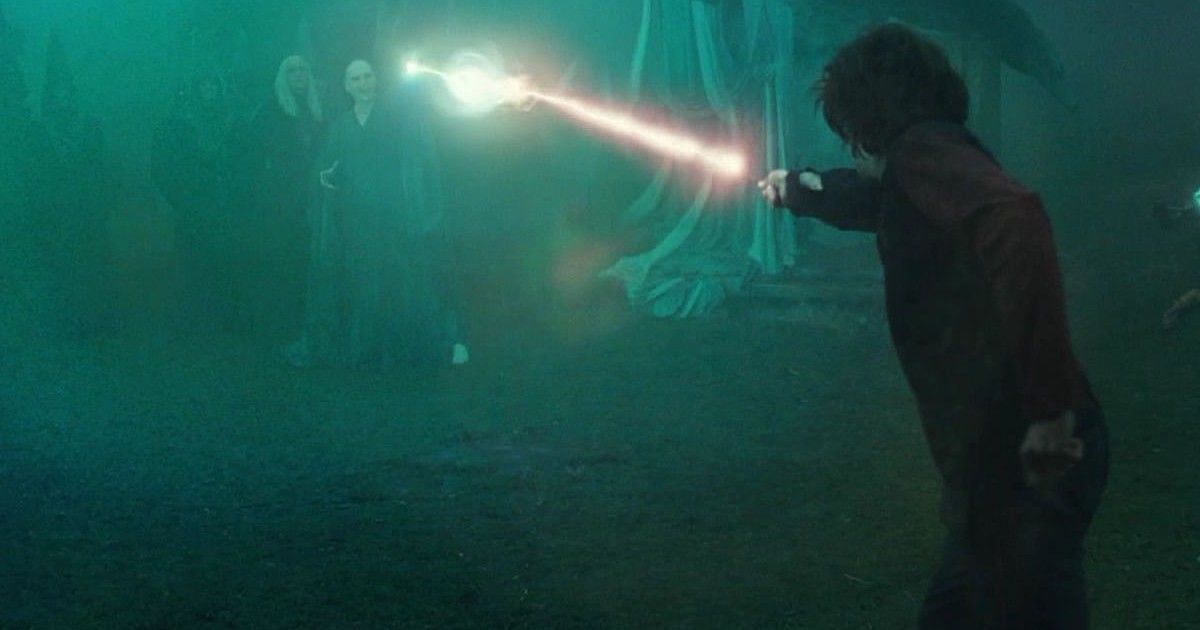
Wands are weird. In the Wizarding World, they’re basically sentient wooden sticks that decide if they like you or not based on your personality quirks and whether or not you've got "character." It’s honestly a bit temperamental. Most fans focus on the Elder Wand because, well, it’s the "Deathstick," but if we’re talking about the coolest wands in Harry Potter, the real winners are the ones with history, bizarre materials, or designs that actually tell us something about the person holding them.
Forget raw power for a second.
Let's talk about why Lucius Malfoy’s cane is a flex or why Bellatrix’s wand looks like a literal bird’s talon. It’s about the vibe.
The Elder Wand is the Obvious Choice (But Maybe Overrated)
Look, we have to start here. It’s the one everyone knows. It’s made of elder wood—which according to wandlore is the unluckiest wood ever—and contains a tail hair from a Thestral. This is actually a huge deal because Thestrals are only visible to people who have seen death. It’s morbid. It’s dark. It’s exactly what you’d expect from a literal Gift of Death.
But here’s the thing: the Elder Wand is basically a curse. It doesn't want to be loyal. It’s like that one friend who leaves the party the second someone cooler shows up. While it’s technically the most powerful, its "coolness" comes more from its bloody history than its actual utility. It has passed through the hands of killers like Emeric the Evil and Barnabas Deverill. It’s a trophy, not a tool.
Honestly, the coolest thing about it isn't even the power. It's the design. In the films, those weird circular nodules (the "clusters") make it look ancient and organic, like something that grew out of a graveyard. It doesn't look like it was carved; it looks like it evolved.
Bellatrix Lestrange and the Curve of Chaos
If you want to talk about a wand that matches its owner’s energy perfectly, you’ve gotta look at Bellatrix Lestrange’s wand. It’s 12 and three-quarter inches of Walnut with a Dragon Heartstring core. But look at it. It’s curved.
Most wands are straight, like a conductor’s baton. Bellatrix’s wand has this wicked, ergonomic bend that makes it look like a claw. Garrick Ollivander described it as "unyielding," which is a polite way of saying the wand is as stubborn and narrow-minded as the woman who used it to torture the Longbottoms. There is something deeply unsettling about a wand that looks like it was designed specifically for casting Crucio. It’s a predator’s tool.
Walnut wands are usually drawn to highly intelligent innovators, which tells us something scary about Bellatrix. She wasn't just a chaotic loon; she was brilliant in her own twisted way. The wand's shape allows for a more aggressive "whipping" motion in duels, which is why she was able to hold her own against three witches at once during the Battle of Hogwarts.
Lucius Malfoy: The Ultimate Accessory
Lucius Malfoy didn't just have a wand. He had a statement piece. His wand is Elm, 18 inches (including the handle), with a Dragon Heartstring core. But the "cool" factor here is the cane.
The wand is hidden inside a walking stick topped with a silver snake head. This is purely for intimidation. Elm wands are notoriously difficult to master and usually prefer owners with "presence" and a certain "native dignity." Lucius has the presence, sure, but he also has a massive ego.
There’s a specific scene in Chamber of Secrets where he uses the bottom of the cane to shove Harry’s hand away. It’s a weapon even when the wand isn't out. That’s clever design. It blends pure-blood elitism with practical concealment. When Voldemort eventually takes it from him and snaps the head off, it’s a symbolic castration. Without his fancy stick, Lucius is nothing.
Fleur Delacour and the Hair of a Grandmother
Fleur’s wand is weirdly personal. Most wands use cores from magical beasts like Phoenixes or Unicorns, but Fleur’s wand contains a hair from her grandmother, who was a Veela. This makes it one of the most unique wands in the entire series.
Ollivander famously called Veela hair cores "temperamental." This makes sense. The wand is 9 and a half inches of Rosewood, a material that usually pairs well with people who are deeply loved or possess great beauty. It’s an elegant, feminine wand that represents her heritage.
While everyone else is carrying around bits of dead dragons or birds, Fleur is literally carrying a piece of her family. That’s a different kind of "cool." It’s not about being the biggest or the baddest; it’s about identity.
Lord Voldemort’s Bone-White Terror
Tom Riddle’s wand is Yew, 13 and a half inches, with a Phoenix Feather core. Yew trees are famous for two things: living for thousands of years and being incredibly poisonous. They represent both death and rebirth.
The design of this wand in the movies is iconic. It looks like a bleached bone. The handle has a small "hook" that looks like a finger bone or a talon, allowing Voldemort to hold it loosely without it slipping. It’s creepy. It’s elegant.
Interestingly, Yew wands are never paired with mediocre wizards. They are always for the outliers—the heroes or the villains. The fact that his wand shares a core with Harry’s (the "Brother Wands") is the ultimate irony. One wood represents death (Yew), while the other (Harry’s Holly) is often associated with protection and the warding off of evil.
Why Wood and Core Actually Matter
If you’re trying to figure out what the coolest wands in Harry Potter are for your own collection or just for lore's sake, you have to look at the wood types. J.K. Rowling based a lot of this on the Celtic Tree Calendar.
- Holly (Harry): Great for people who need to overcome anger. It’s a "protective" wood.
- Vine (Hermione): Given to those who seek a greater purpose. It’s surprisingly sensitive.
- Willow (Ron/Lily Potter): Associated with healing and "the gift of the moon."
Ron’s second wand is actually a great example of growth. His first wand was a hand-me-down from Charlie, which is why he was so bad at magic early on—the wand never chose him. His second wand, 14 inches of Willow with Unicorn hair, was "his." It’s a reminder that in this universe, you can't just buy power. You have to earn the respect of the tool.
The Wand That Doesn’t Get Enough Love: Sirius Black
Sirius Black’s wand is covered in runes. We don't actually know the wood or core for certain from the books, but the prop design is fascinating. The square-ish shape and the engravings suggest someone who comes from an old, "proper" family but has been marked by time and struggle.
The runes on it look like tattoos. It feels rebellious. For a man who spent twelve years in Azkaban, having a wand that looks like it was etched by hand in a prison cell (even though he had it before) is just... cool. It’s rugged. It’s the leather jacket of wands.
How to Choose Your Own "Cool" Wand
If you're looking to buy a replica or just want to "identify" your own wand type, don't just go for the Elder Wand because it’s the most famous. Look at the characteristics that actually matter.
- Length matters: Longer wands often go to "big" personalities (not just tall people).
- Flexibility: A "swishy" wand is better for charms, while a "rigid" wand is usually for someone who is set in their ways.
- The Core: Dragon Heartstring is for power, Unicorn Hair is for consistency (and it’s the hardest to turn to the Dark Arts), and Phoenix Feather is the rarest.
The coolest wand is the one that tells a story. Neville Longbottom using his father's wand for years was a sign of his insecurity; when it finally broke and he got his own wand (Cherry and Unicorn hair), his magic improved instantly. That's the real magic of wandlore. It's a reflection of the soul.
Actionable Insights for Fans and Collectors
- Research the Wood: If you're buying a replica, look up the Celtic meaning of the wood. It adds a layer of depth to the item on your shelf.
- Check the Core Lore: Understand that a Dragon Heartstring wand (like Hermione’s or Bellatrix’s) is prone to accidents if the owner isn't careful.
- Look Beyond the Movies: Some of the best wand descriptions come from the Wizarding World (formerly Pottermore) archives written by Rowling. They explain why certain wands "refuse" to work for certain people.
- Focus on the Handle: For cosplayers, the handle is where the personality is. Lucius Malfoy’s cane or Slughorn’s slug-motif handle are much more visually interesting than a standard brown stick.
The world of wands is basically a study in psychology. The coolest ones aren't necessarily the ones that win the most duels; they're the ones that feel like a physical extension of the wizard's flaws and strengths. Next time you re-watch the films or re-read the books, look at the wands as characters themselves. They usually have more to say than the people holding them.