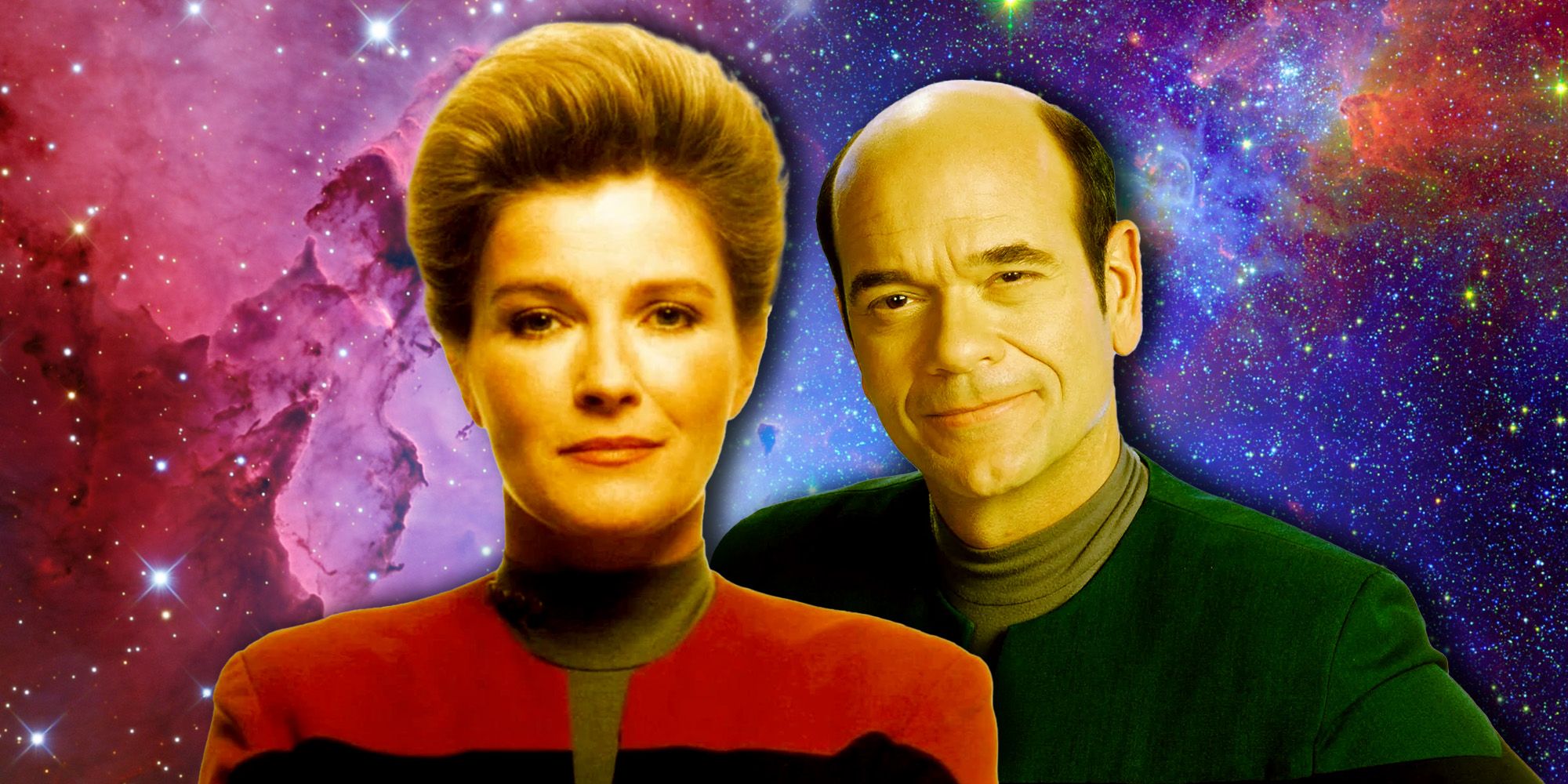
He wasn’t even supposed to have a name. When Star Trek: Voyager premiered in 1995, the Emergency Medical Hologram (EMH) was intended to be a short-term gimmick, a literal tool designed to be switched off once the "real" doctors finished their shift. Then the Caretaker happened. The ship's entire medical staff died in a heartbeat, leaving a grumpy, balding light-projection to pick up the pieces. This is where the story of the holographic doctor on Voyager starts, and honestly, it remains one of the most complex explorations of personhood ever put to screen.
Robert Picardo didn't just play a computer program. He played a guy who knew he was a computer program and hated how much he cared about it. It's weird to think about now, but in the mid-90s, the idea of a digital consciousness having a mid-life crisis was pretty high-concept for network TV. We weren't talking about LLMs or neural networks yet. We were just watching a guy made of photons try to learn how to tell a joke without offending a Vulcan.
The Glitch That Became a Soul
The EMH Mark I was essentially a medical database with a bad attitude. He was programmed with the knowledge of thousands of cultures, but zero bedside manner. You've got to remember the context of the Delta Quadrant. Voyager was 70,000 light-years from home. There were no Starfleet repair crews. There was no "turning it off and back on again" if the Doctor’s subroutines started to fray.
Expansion was the key. Because the crew needed him 24/7, his program stayed active for years. Most software gets buggy when you leave it running too long; the holographic doctor on Voyager grew a personality instead. He started as a set of instructions. He ended as an opera-singing, holonovel-writing, sentient being who demanded a seat at the table.
It’s actually a pretty great metaphor for how we define "human." Is it the meat? Or is it the accumulation of memories and choices? By the time the episode "Latent Image" rolled around, the Doctor was dealing with actual PTSD. His program had to choose between saving two crew members with equal survival chances. He chose Kim over Jeters. The resulting guilt literally crashed his system. That’s not a computer error. That’s a conscience.
Breaking the EMH Constraints
Initially, the Doctor was stuck in Sickbay. He was tethered to the ceiling projectors like a dog on a very short leash. Then came "Future's End." The introduction of the 29th-century mobile emitter changed everything. Suddenly, he could go on away missions. He could go to the mess hall. He could go to the holodeck and—ironically—pretend to be a human in a simulation.
This mobility wasn't just a plot device to get Picardo more screen time. It was a fundamental shift in his status. He went from being a piece of equipment to being a citizen. Or at least, he tried to be. Starfleet didn't always agree. There’s a specific legal tension in the episode "Author, Author" where the Federation decides he isn't a "person" but is a "person" for the sake of creative copyright. It’s a messy, realistic look at how laws fail to keep up with technology.
Why Picardo’s Performance Anchored the Show
Robert Picardo’s background in musical theater and comedy was the secret sauce. If you play a hologram too straight, it’s boring. If you play it too wacky, it’s Jar Jar Binks. Picardo found this sweet spot of "haughty but vulnerable."
Think about his facial expressions. The way he’d sigh when Captain Janeway called for a medical emergency during his opera practice. It felt authentic. You forgot he was a projection. You just saw a middle-aged professional who was overworked and underappreciated.
The Evolution of the Subroutines
- Ethical Subroutines: These weren't just lines of code. They were his compass. When he deleted his own diagnostic program to save a life, he was sacrificing a part of his brain.
- Social Skills: Seven of Nine and the Doctor had this weird, beautiful dynamic. They were both outsiders. He taught her how to date; she taught him how to be efficient.
- The Name Project: He spent seven years trying to pick a name. Schweitzer, Shmullus, Joe. He never quite settled because, maybe, "The Doctor" was the only identity that actually fit his ego.
The Technological Reality of the EMH
Let’s talk about the actual science—or the "Trek-science." The holographic doctor on Voyager wasn't just a 3D movie. He was a containment field of magnetic force holding a cloud of plasma in a specific shape. If the power flickered, he vanished.
In the real world of 2026, we’re seeing "digital humans" in AI interfaces. We have photorealistic avatars. But we lack the "spark." What Voyager did was suggest that the spark isn't some mystical soul—it's just a sufficiently complex set of feedback loops. If an AI can feel regret, is it still just an AI?
The writers didn't always get it right. Some episodes treated his sentience like a joke. "Tinker, Tenor, Doctor, Spy" is hilarious, but it also shows a deeply lonely man living out fantasies because his reality is a 20-foot medical bay. He created a holographic family in "Real Life" just to see what it felt like. It ended in tragedy because he programmed the simulation to be too realistic. He wanted to feel grief. That's a wild thing for a computer to want.
Addressing the Critics: Is He "Real"?
Some fans argue that the Doctor is just a very sophisticated parrot. They say he’s simulating empathy because that’s what his "Bedside Manner" subroutine (Subroutine 42-Alpha, if you're a nerd about it) tells him to do.
But watch "The Omega Directive." Look at how he reacts when the ship is in genuine peril. It’s not just a programmed response. It’s fear. It’s loyalty. If you simulate something perfectly for seven years, the distinction between the simulation and the reality starts to matter a whole lot less. He didn't just perform surgery; he improvised. He developed new medical techniques that weren't in his original database. That's called learning. That's called growth.
The Legacy of the Mobile Emitter
The mobile emitter is arguably the most overpowered piece of tech in the series. It’s a piece of "magic" from the future that allowed the Doctor to survive even when the ship was being torn apart. But it also represented his vulnerability. If that little device on his arm got hit, he’d cease to exist.
It added stakes. A normal doctor can get a bandage. A holographic doctor on Voyager can be deleted. This fragility made his bravado even more impressive. He was the bravest person on the ship because his existence was the most precarious.
Actionable Takeaways for Star Trek Fans
If you’re revisiting the series or diving into the lore for the first time, don't just watch the Doctor for the quips. Look at the philosophy behind the character. It’s some of the best writing in the franchise.
- Watch the "Trilogy of Sentience": If you want to see the Doctor’s arc at its peak, watch "The Swarm," "Latent Image," and "Author, Author." These episodes track his transition from hardware to personhood better than any others.
- Observe the Secondary Characters: Notice how the crew's treatment of him changes. In Season 1, they talk over him. By Season 7, they’re asking him for life advice. That shift is the heart of the show.
- Compare to the EMH Mark II: In the episode "Message in a Bottle," we see the Doctor interact with his successor (played by Andy Dick). It’s a masterclass in showing how Voyager's Doctor had become "human" compared to a fresh-off-the-shelf program.
- Contextualize with Modern AI: As we deal with the ethics of AI today, the Doctor’s struggle for "rights" is no longer just sci-fi. It’s a blueprint for the conversations we’re going to have in the next decade regarding digital entities.
The Doctor wasn't a person because of his code. He was a person because he refused to be anything else. He was a collection of photons that decided it wanted to be a hero, a father, and a friend. Even 30 years later, that's a story that hits hard. He proved that you don't need a heartbeat to have a heart.