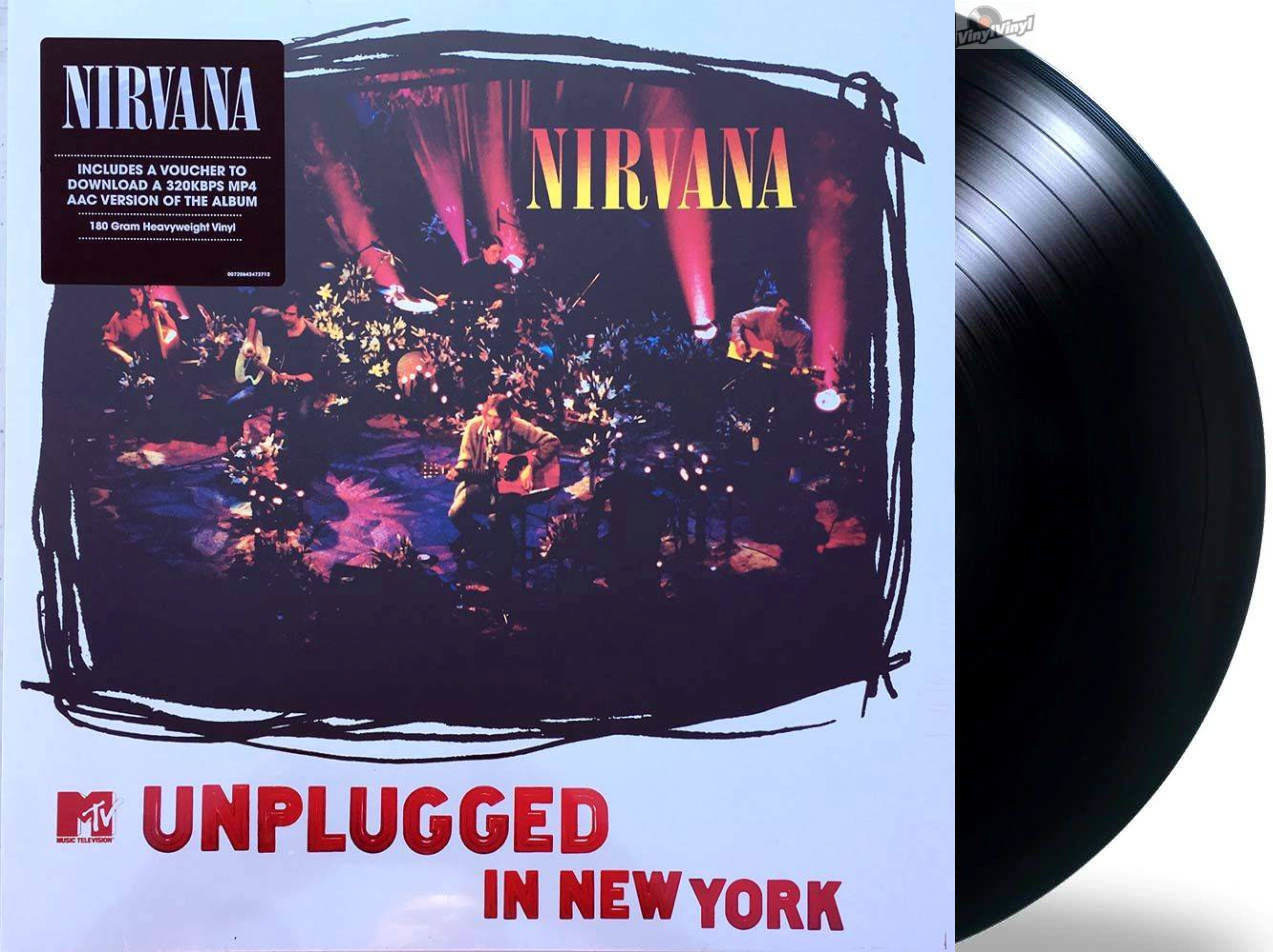
You can almost smell the lilies. It’s November 18, 1993, at Sony Music Studios in Hell's Kitchen, and Kurt Cobain is terrified. He’s surrounded by stargazer lilies and black candles, a setup he requested because he wanted the stage to look like a funeral. Most people don’t realize how close this whole thing came to being a total disaster. The rehearsals were famously bad. Kurt was suffering from drug withdrawal, the band couldn't get the acoustic arrangements right, and MTV executives were sweating because there wasn't a "Smells Like Teen Spirit" in sight. Yet, decades later, the MTV Unplugged in New York vinyl remains the definitive way to experience what turned out to be Nirvana’s swan song.
Vinyl just handles this performance differently. When you drop the needle on "About a Girl," you aren't just hearing a song; you're hearing the room. You hear the floorboards creak. You hear the slight, nervous rasp in Kurt’s throat before he launches into a setlist that defied every expectation of a "grunge" band at the height of their powers.
The Raw Physics of the Unplugged in New York Vinyl
Digital files are clean. Maybe too clean. For a performance that is defined by its intimacy and its flaws, the compression of a standard MP3 or even a high-res stream can sometimes strip away the "air" around the instruments. On the Unplugged in New York vinyl, specifically the more recent 25th-anniversary reissues or the original 1994 DGC pressings, the acoustic guitar sounds massive. It’s thick.
Kurt played a 1950s Martin D-18E through a Fender Twin Reverb amp. It’s a weird hybrid sound. It’s an acoustic guitar, but it’s electrified in a way that gives it this warm, fuzzy low-end that sounds incredible on an analog setup. If you have a decent pair of speakers, you can actually hear the pick hitting the strings during "Pennyroyal Tea." It’s that close.
Dave Grohl’s drumming is another revelation on the record. He had to learn how to play with brushes and sizzle sticks because he usually hits the drums like he’s trying to break them. On the vinyl, you get the full decay of those cymbals. It doesn't just cut off; it fades into the background noise of the New York audience. It’s haunting, honestly.
What Most People Get Wrong About the Recording
There is a common myth that this was a "one take and done" spontaneous jam. It wasn't. The band spent two days agonizing over the arrangements. They even brought in Pat Smear and Lori Goldston on cello to fill out the sound because Kurt felt the three-piece setup sounded too thin without the wall of distortion they usually hid behind.
If you look at the tracklist, it’s a masterclass in curation. They ignored the hits. No "Lithium." No "Heart-Shaped Box." Instead, they gave us David Bowie, The Vaselines, and three songs by the Meat Puppets. When the Meat Puppets brothers, Cris and Curt Kirkwood, walked onto that stage, the MTV producers were reportedly confused. They wanted Pearl Jam or Eddie Vedder. Kurt gave them the Kirkwood brothers.
Listening to the Unplugged in New York vinyl reveals the nuance of these collaborations. During "Lake of Fire," the vocal harmonies are slightly off-kilter in the best possible way. It feels human. In an era where everything is quantized and pitch-corrected, this record stands as a monument to the beauty of being slightly out of tune.
Pressing Variations and What to Look For
If you’re hunting for a copy, you’ve basically got three main choices:
- The 1994 Original Pressing: These are the holy grail. Usually pressed on white vinyl in Europe or black in the US. They are expensive. Are they worth it? For a collector, yes. For a casual listener, the price tag (often $300+) is a steep barrier.
- The 2009 ORG Music Reissue: This is the "audiophile" choice. Mastered by Bernie Grundman. It’s widely considered the best-sounding version of the album. It’s pressed on heavy 180-gram vinyl and has a dynamic range that makes the digital version sound like it’s being played through a telephone.
- The 25th Anniversary Edition: This one is great because it includes the rehearsal tracks. You get to hear the band figuring it out. It’s less polished, but for a fan, hearing them stumble through "Come As You Are" before perfecting it is a gold mine of insight.
The "Where Did You Sleep Last Night" Moment
We have to talk about the ending. Lead Belly’s "Where Did You Sleep Last Night." It is widely regarded as one of the greatest single live performances in the history of rock music.
On the vinyl, the tension is palpable. The song builds and builds until that final scream. But it’s not just a scream. It’s a crack. If you listen closely—really closely—you can hear Kurt catch his breath and open his eyes right at the very end. The producers asked him to do an encore. He refused. He knew he couldn't top that moment. He knew he had nothing left to give.
That silence after the last note fades? It feels longer on vinyl. You have to physically get up to lift the needle. It forces a moment of reflection that you just don't get when an algorithm immediately shuffles you into a Foo Fighters track.
Why This Record Matters in 2026
We live in a world of AI-generated art and perfectly polished pop. The MTV Unplugged in New York vinyl is the antithesis of that. It is a document of a human being in pain, trying to find beauty in simplicity. It’s an album that shouldn't have worked. A loud band going quiet? Usually a gimmick. Here, it was a stripping away of the mask.
It’s also one of the few albums where the "Unplugged" version is arguably more famous than the studio counterparts. "The Man Who Sold the World" belongs to Nirvana now. Sorry, Bowie. Even David Bowie himself said he was blown away by how Kurt reimagined it.
Actionable Steps for Vinyl Collectors and Nirvana Fans
If you want to experience this properly, don't just buy the cheapest copy you see at a big-box retailer.
- Check the Matrix Runout: Look for "P.USA" or "Bernie Grundman" signatures in the dead wax of the record. These indicate a higher quality master.
- Invest in a Cleaning Kit: Acoustic recordings suffer the most from "pops and clicks." Even a new record should be cleaned with a carbon fiber brush to remove static.
- Listen in the Dark: Sounds pretentious, but try it. This album was recorded in a "funeral" setting. Dim the lights, sit between your speakers, and let the 1993 New York atmosphere take over.
- Compare the Rehearsals: If you get the 25th-anniversary set, listen to the rehearsal side first. It makes the final performance feel like a much bigger victory.
- Don't Overpay for Color: While the purple or orange swirl variants look cool on Instagram, the black 180g ORG pressings usually offer the superior sonic experience.
The MTV Unplugged in New York vinyl is more than just a piece of plastic. It’s the final testament of a generation's most reluctant icon. It’s raw, it’s uncomfortable, and it’s perfect. If your turntable is gathering dust, this is the record that justifies its existence. Put it on, drop the needle, and just listen.