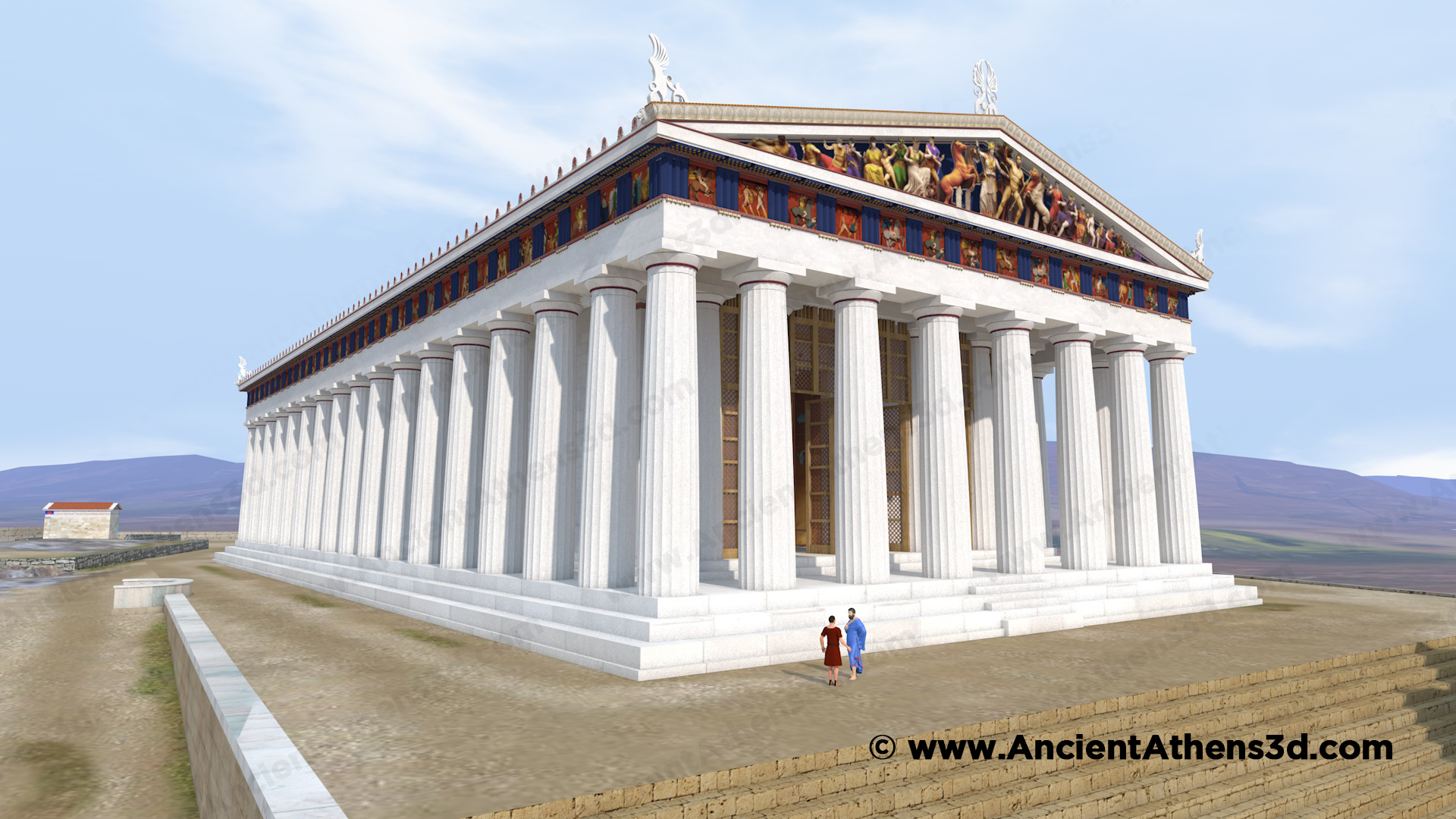
You’ve seen the photos. Those massive, honey-colored columns standing high above the smog of modern Greece. It’s the Parthenon of Athens, the ultimate symbol of Western civilization, or so the textbooks tell us. But honestly? Most people who visit the Acropolis are looking at a building they don't actually understand. They see a ruin. They see marble. What they miss is that this entire structure is a massive, 2,500-year-old optical illusion designed to mess with your brain.
It’s not straight. That’s the first thing you have to wrap your head around. There isn't a single truly horizontal or vertical line in the entire building. If the architects, Ictinus and Callicrates, had built it "correctly" with perfectly 90-degree angles, the whole thing would look sagging and distorted to the human eye. To make it look perfect, they had to build it crooked.
The Parthenon of Athens and the lie of the straight line
When you stand at the base of the steps, you’d swear they are flat. They aren't. The floor—the stylobate—actually curves upward in the middle. If you put a hat on one end of the step, someone standing at the other end wouldn't be able to see it because of the "bulge" in the floor.
Why do this? Because the Greeks understood entasis.
They knew that if you make a column perfectly straight, it looks thin and weak in the middle. So, they gave the columns a slight "belly" or swelling. It makes the stone look like it’s under the heavy weight of the roof, almost like it’s breathing or straining under the load. It gives life to dead rock. The columns also lean slightly inward. If you projected the lines of the Parthenon of Athens columns thousands of feet into the sky, they would eventually meet to form a giant pyramid.
It’s a masterclass in psychological architecture. It wasn’t just built to house a statue; it was built to dominate the viewer's perception of reality.
The gold and ivory giant you can't see anymore
We think of the Parthenon as this white, pristine skeleton. It’s elegant. It’s "classical." But back in 438 BCE, it was loud. It was garish. It was covered in bright blues, deep reds, and shimmering golds.
Inside sat the Athena Parthenos.
This wasn't some little marble statue. It was a 40-foot-tall behemoth made of chryselephantine—gold and ivory. Created by Phidias, the statue used about 1,140 kilograms of gold. That gold wasn't just for decoration; it was the city's emergency reserve fund. The plates could be removed and melted down if Athens ever went broke during a war. Imagine walking into a dim, torch-lit room and seeing a four-story woman made of glowing ivory and solid gold staring back at you. It would have been terrifying.
People often forget that the Parthenon of Athens wasn't exactly a "temple" in the traditional sense. It didn't have an altar outside for sacrifices like most Greek temples. It was more of a treasury and a giant votive offering. It was Pericles showing off. He used the money from the Delian League—basically a protection racket Athens ran with other Greek city-states—to fund the construction. It was the world's most beautiful misappropriation of defense funds.
Why the building is falling apart (and why it's taking so long to fix)
If you visit today, you’ll see cranes. You’ll see scaffolding. You might think, "Man, they’ve been working on this forever." They have. The current restoration project has been going since 1975.
The problem is that earlier "fixes" actually tried to kill the building.
In the early 20th century, a guy named Nikolaos Balanos tried to reconstruct parts of the temple. He used iron clamps to hold the marble together. He didn't realize that iron rusts and expands. As the iron grew, it cracked the ancient Pentelic marble from the inside out. It was a disaster. Now, modern restorers have to painstakingly remove every single one of those iron clamps and replace them with titanium, which won't corrode.
The 1687 explosion that changed everything
For about 2,000 years, the Parthenon was actually in pretty good shape. It survived being turned into a Christian church (Our Lady of Athens) and later a mosque under Ottoman rule. The real tragedy happened on September 26, 1687.
The Venetians were besieging Athens. The Ottomans, thinking the Venetians wouldn't dare blow up a historic monument, used the Parthenon of Athens as a gunpowder magazine.
They were wrong.
A Venetian mortar hit the roof. The resulting explosion blew the center of the building out. Huge chunks of marble flew everywhere. The roof collapsed. The friezes shattered. Most of the "ruin" we see today is the result of that one single night of bad military strategy.
The Elgin Marbles: A fight that won't end
You can't talk about the Parthenon without talking about the British Museum. Around 1801, Lord Elgin, the British Ambassador to the Ottoman Empire, started removing sculptures from the Acropolis. He claimed he had a permit (a firman) from the Sultan, though the original document has never been found.
He took about half of the surviving sculptures.
Today, Greece wants them back. The Acropolis Museum in Athens has a massive glass-walled gallery that mirrors the exact dimensions of the Parthenon. They’ve placed the original pieces they still have alongside plaster casts of the ones in London. It’s a very pointed, very visual protest. The British Museum argues that Elgin "saved" the marbles from destruction and that they are "world heritage" best kept in a global museum. Greece argues they were stolen while the country was under foreign occupation.
It’s one of the longest-running cultural disputes in history. It's not just about art; it’s about national identity.
Pentelic marble is basically magic
The stone used for the Parthenon of Athens is special. It comes from Mount Pentelicus, about 16 kilometers away. It’s a fine-grained marble that contains a tiny bit of iron.
Over time, that iron oxidizes.
This is why the Parthenon isn't stark white like the marble you see in a bathroom. It has a warm, honey-colored patina. When the sun sets over the Saronic Gulf, the building seems to glow from within. The ancient builders knew exactly what they were doing when they chose this specific quarry. They weren't just building for the present; they were building for the light.
What most tourists get wrong when they visit
Usually, people hike up the hill, take a selfie, and leave. They miss the details.
Look at the metopes—the carved panels above the columns. They depict battles: gods vs. giants, Greeks vs. Amazons, Lapiths vs. Centaurs. These aren't just random myths. They are propaganda. They represent the "civilized" world (Athens) defeating "barbarism" (the Persians). The Parthenon was built shortly after the Greeks beat the Persian Empire, and the whole building is basically a "we told you so" carved in stone.
Also, notice the floor. It’s not just curved; it has drain holes. Even in 400 BCE, they were worried about rainwater pooling and damaging the foundations. The engineering is as impressive as the art.
Practical reality: How to actually see it
If you want to feel the weight of this place, don't go at 11:00 AM. You’ll be surrounded by 5,000 people with selfie sticks and it will feel like a theme park.
Get there at 7:45 AM. Stand at the gate. When they open at 8:00 AM, run—don't walk—up the slippery limestone path. For about ten minutes, you might have the Parthenon of Athens to yourself. You can hear the wind whistling through the columns. That’s when you realize it’s not just a pile of rocks. It’s an attempt at immortality.
Actionable steps for your next visit
If you’re planning to see this site, don't just wing it.
- Buy your tickets online in advance. The line at the ticket office can be two hours long in July. Use the official Hellenic Heritage site.
- Visit the Acropolis Museum first. It’s at the foot of the hill. It gives you the context of what was inside the building before you see the outside.
- Wear shoes with grip. The limestone on the Propylaea (the entrance gate) has been polished smooth by millions of feet over thousands of years. It’s like walking on ice.
- Look for the "marks." On the floor of the Parthenon, you can still see the faint circles where the massive bronze doors used to swing open.
- Check the weather. There is zero shade on top of the Acropolis. If it’s 40°C (104°F), you will bake. Go early or go late.
The Parthenon of Athens is more than a monument. It’s a reminder that even when things break—even when they are blown up, looted, and eroded—the intentionality behind them stays. Those curved lines are still tricking your eyes today, exactly the way they did 2,500 years ago. That's a hell of a legacy.