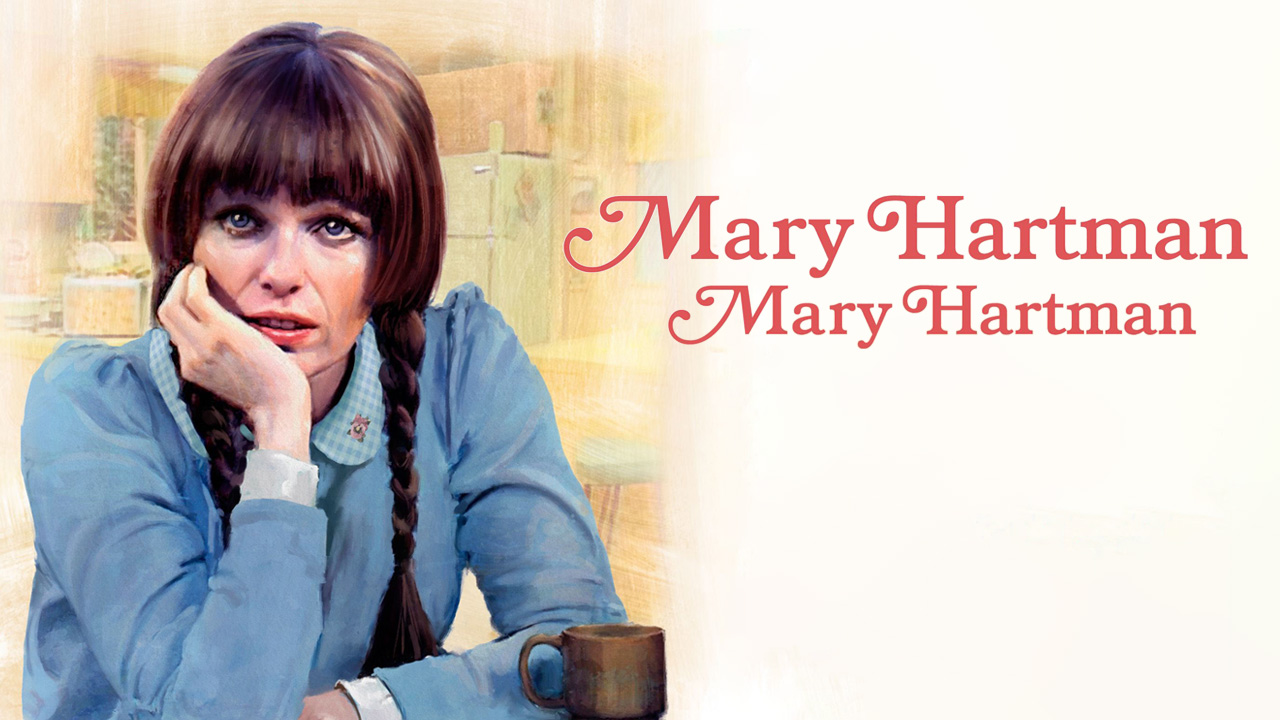
You’re sitting in a wood-panneled living room in 1976. The air is thick with the scent of Tab soda and Benson & Hedges. Suddenly, a woman’s voice wails from the television: "Mary Hartman! Mary Hartman!" It sounds like a distress call. It basically was.
The tv show Mary Hartman was a fever dream. Produced by the legendary Norman Lear, it was a half-hour, five-night-a-week syndicated experiment that didn't just parody soap operas—it dissected the American soul with a rusty kitchen knife. Most people today remember it as "that weird show with the pigtails," but it was actually a brutal, hilarious, and deeply tragic look at how consumerism and media rot the human brain.
The Waxy Yellow Buildup of the Human Spirit
The premise sounds like a joke. Mary Hartman, played by the hauntingly talented Louise Lasser, is an Ohio housewife who can’t tell the difference between a mass murder in her neighborhood and the "waxy yellow buildup" on her kitchen floor. To Mary, both are crises of equal magnitude because that’s how television presented them. A commercial for floor wax had the same urgency as a news report on a massacre.
It was satire, sure. But it was played dead straight.
There was no laugh track. None. If something was funny, you had to figure it out yourself while the characters stared into the middle distance with glazed eyes. This lack of a "humor map" made many viewers deeply uncomfortable. Stations didn't know where to put it. The big three networks—ABC, CBS, and NBC—all famously passed on it. Fred Silverman, then a programming genius at CBS, reportedly called it the best show he’d ever seen but insisted it could never be on a network.
So, Lear took it to syndication. He sold it station-by-station, often airing it at 11:30 PM after the local news. This "late-night" slot gave the writers, including Gail Parent and Ann Marcus, the freedom to talk about things that were strictly taboo in 1976:
- Impotence (Mary's husband, Tom, played by Greg Mullavey, struggled with this for months)
- Religious hypocrisy (the child evangelist Jimmy Joe Jeeter)
- Sexual frustration
- Mental health collapses
A Cast of Fernwood Misfits
The town of Fernwood, Ohio, was populated by people who felt like they were vibrating on a different frequency. Mary Kay Place played Loretta Haggers, an aspiring country star who was so relentlessly optimistic it felt like a mental illness. She actually won an Emmy for the role, and even released a real-life country album in character.
Then you had:
- Martha Shumway (Dody Goodman): Mary’s mother, who talked to her plants because the humans around her were too exhausting.
- Cathy Shumway (Debralee Scott): Mary’s sister, a "man-eater" who existed as the polar opposite of Mary’s repressed domesticity.
- Grandpa Larkin (Victor Kilian): The "Fernwood Flasher." The show’s first big shocker was revealing that the town's local pervert was Mary's own grandfather.
The bizarre nature of the plotlines is still shocking. A basketball coach drowns in a bowl of Mary’s chicken soup. A character is fatally impaled by an aluminum Christmas tree. It was "Twin Peaks" a decade before David Lynch ever stepped foot in a studio.
Why It Broke Louise Lasser
The production schedule was a nightmare. They were churning out five episodes a week. Lasser was in nearly every scene, and her character was perpetually on the edge of a nervous breakdown. The line between the actress and the character began to blur.
In one of the most famous moments in television history, the first season ends with Mary having a full-blown breakdown on a fictionalized version of The David Susskind Show. It’s an eleven-minute, single-shot scene where Mary finally snaps under the pressure of being the "perfect" housewife. It’s harrowing. It’s not "funny" in any traditional sense.
Lasser eventually left the show in 1977, exhausted and overwhelmed. The show tried to continue as Forever Fernwood without her, but the magic—the specific, twitchy, anxious magic of Mary—was gone.
The Legacy of a "Failed" Experiment
Is the tv show Mary Hartman a failure? Not really. It was a massive hit in its time, landing on the covers of Newsweek and Time. It changed the way we think about "dramedy." Without Mary Hartman, we don't get Soap, we don't get The Larry Sanders Show, and we certainly don't get the "prestige" cringe-comedy of the 2020s.
It’s a tough watch today because it’s so slow. It mimics the pacing of 1970s daytime soaps, which were designed to be watched while ironing or doing dishes. But if you sit with it, the genius reveals itself. It’s a show about how we use products and media to fill the empty spaces in our lives.
Mary thought that if she could just find the right detergent, her husband would love her again and the world would stop being so scary. We’re still doing that. We just do it on TikTok now instead of in a Fernwood kitchen.
Next Steps for the Curious:
If you want to experience the tv show Mary Hartman for yourself, look for the complete series box set from Shout! Factory. It’s the only way to see the episodes in their original, unedited glory. Start with the first week of episodes—the "Mass Murder" arc—to see exactly how Norman Lear managed to make the most depressing topics on earth feel like a suburban circus. You might also want to track down Mary Kay Place's album Tonite! At the Capri Lounge Loretta Haggers to hear just how deep the "meta" layers of this show really went.