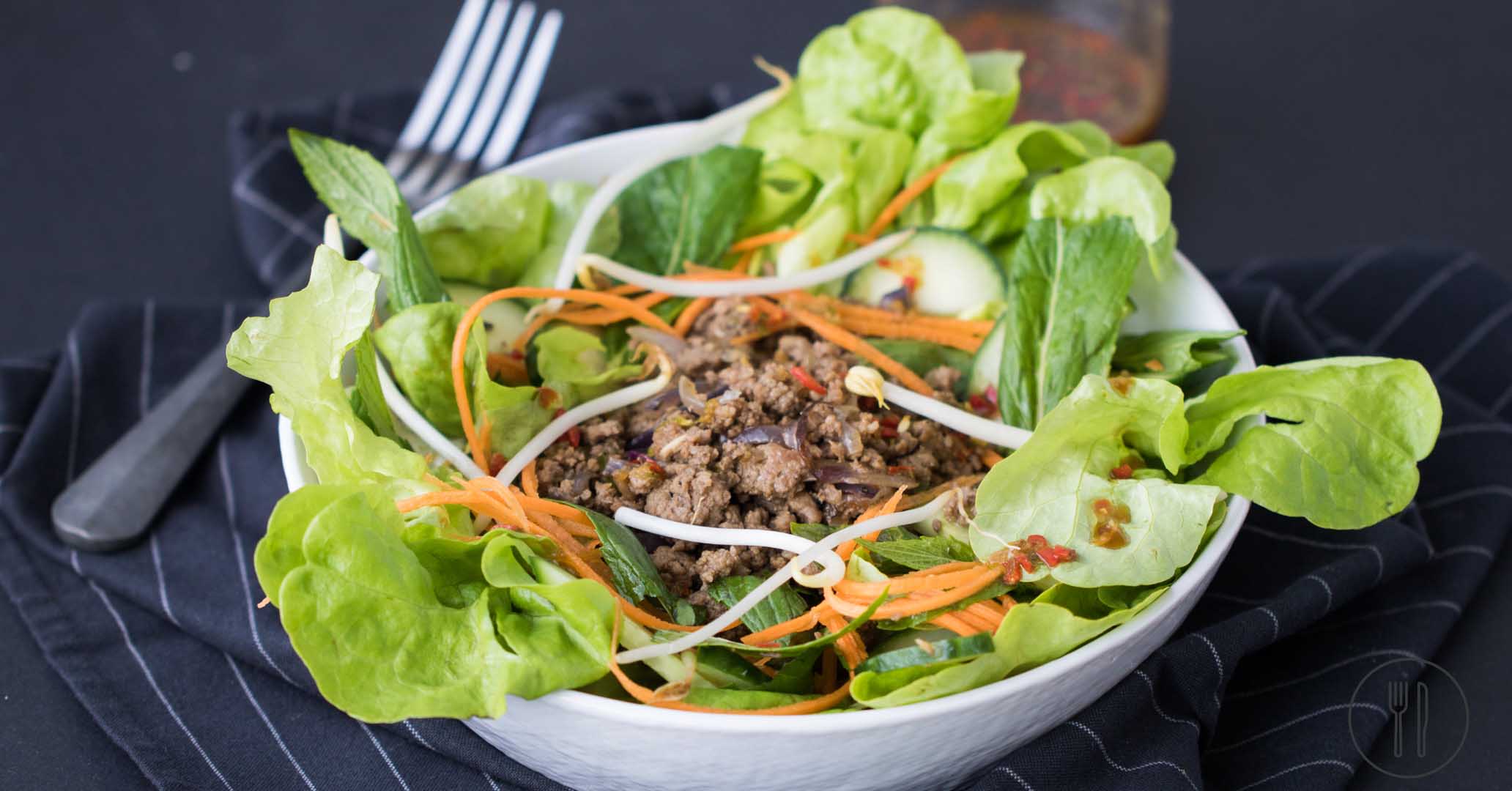
Larb is loud. It is a riot of lime, fish sauce, and chili that hits your tongue like a physical weight, yet somehow leaves you feeling light. Most people think they’ve had a proper thai larb salad recipe because they ordered it at a local takeout joint, but usually, what they got was a muted, sweetened version that misses the point entirely. Authentic larb isn't a "salad" in the western sense of leafy greens and ranch dressing; it’s a meat-forward dish from the Isan region of Northeast Thailand and Laos that relies on a very specific, smoky crunch to tie everything together.
If you don't smell something slightly toasted and nutty while you're cooking, you're doing it wrong.
The Secret Ingredient You Probably Skip
Let’s talk about khao khua. Honestly, if you aren't making your own toasted rice powder, don't even bother calling it larb. This isn't just a garnish or a thickener. It is the backbone. You take raw glutinous rice (sticky rice), toss it into a dry pan, and shake it over medium heat until it turns a deep, golden brown. It should smell like popcorn. Then you smash it in a mortar and pestle.
You want a coarse grit, not a fine flour. That grit provides a texture that contrasts against the soft, crumbled meat. It also absorbs the lime juice and fish sauce, turning them into a sort of savory paste that clings to the pork or chicken. Without it, your larb is just soggy ground meat sitting in a puddle of juice.
Getting the Meat Right
Most Americanized versions use lean ground turkey or chicken breast. Stop.
Isan food is rustic. Traditional thai larb salad recipe variations—specifically Larb Moo (pork)—thrive on a bit of fat. If you can, buy a pork shoulder and hand-mince it with a heavy knife or cleaver. Hand-mincing creates varied textures—some chunks are tiny, some are a bit bigger—which makes the eating experience way more interesting than the uniform "worms" that come out of a grocery store meat grinder.
In Thailand, they often include offal like liver or skin for chew and iron-rich depth. You don’t have to go that far if it's not your vibe, but at least ensure your meat isn't "extra lean." Fat carries the flavor of the bird's eye chilies.
The Heat and the Acid
There is a specific order of operations here. You don't "fry" the meat in oil. Instead, you "water-pop" it. You put the meat in a pot with a tiny splash of water or broth and cook it over medium heat, stirring constantly, until it's just barely cooked through. It stays moist this way.
Then comes the seasoning.
- Fish Sauce: Use a high-quality one like Megachef or Red Boat. It provides the salt and the funk.
- Lime Juice: It must be fresh. Do not even look at that plastic lime-shaped bottle in the pantry.
- Dried Chili Flakes: Prik Bon. These should be toasted too. If you just use standard pizza-parlor red pepper flakes, you'll get heat but no smoke.
Why Fresh Herbs Aren't Just for Show
You need a mountain of herbs. Not a sprinkle. A mountain.
Mint is non-negotiable. Cilantro is a given. But the real pro move is adding culantro (sawtooth coriander) if you can find it at an Asian market. It’s tougher than cilantro and has a much more aggressive, earthy flavor that stands up to the lime juice. Shallots are the final piece. Slice them paper-thin so they soften slightly in the residual heat of the meat but still keep their sharp bite.
Some people add sugar. Some people insist that's a crime. In the south of Thailand, they might add a pinch to balance the salt, but in the North and Isan, the sweetness usually comes from the meat itself and the toasted rice. I'd say skip the sugar first. See if you miss it. Most of the time, the brightness of the lime is enough.
The Cultural Nuance of Larb
Larb isn't just a dish; it's a homophone for the word "luck" or "fortune" in Thai and Lao. It’s celebratory. Because it involves chopping meat finely, it was historically a dish that required labor and was often served at weddings or housewarmings.
There are actually two very different styles of larb in Thailand. The one most of us know is the Isan style (Larb Isan), which is sour and spicy. But there is also Larb Lanna from Northern Thailand (Chiang Mai area). That version is dark, earthy, and doesn't use lime or fish sauce. Instead, it uses prik lap, a complex spice mix containing long pepper, star anise, cloves, and cinnamon. It’s almost medicinal and incredibly deep in flavor. If you ever see "Northern Thai Larb" on a menu, expect something completely different from the zesty, refreshing dish we're talking about here.
Common Mistakes That Ruin the Dish
One of the biggest blunders is adding the herbs while the meat is still piping hot. You'll end up with wilted, black, slimy leaves. Let the meat cool for a minute or two before tossing in the mint and cilantro. They should be vibrant and aromatic when the plate hits the table.
Another issue? Overcooking the meat. Since you're using a small amount of liquid to cook it, the meat can turn into rubber if you leave it on the flame too long. Turn the heat off while the meat is still slightly pink; the residual heat will finish the job while you're adding the aromatics.
Serving It the Right Way
You don't eat larb with a fork. Well, you can, but it’s not the experience. You need sticky rice (Khao Niew). You pull off a hunk of rice, roll it into a ball with your fingers, flatten it slightly, and use it as a scoop to grab the meat and the herbs.
The side platter of raw vegetables is equally important. Cabbage wedges, long beans, and cucumber slices act as "fire extinguishers." When the chili heat starts to build up in the back of your throat, a crunch of raw cabbage neutralizes it so you can go back in for another bite.
Actionable Steps for Your Kitchen
To master this thai larb salad recipe, start with the rice. Toast half a cup of glutinous rice in a skillet until it looks like dark sand. This will last you for several batches if you keep it in a sealed jar.
Next, source your chilies. If you want the real deal, buy dried Thai bird's eye chilies, toast them briefly in a dry pan until they darken slightly, and then grind them. The difference between store-bought chili powder and home-toasted chili powder is like the difference between a grainy black-and-white photo and 4K resolution.
Finally, remember the ratio. For every pound of meat, you're looking at roughly 3 tablespoons of lime juice, 3 tablespoons of fish sauce, and 2 tablespoons of toasted rice powder. Adjust from there. If it doesn't make your mouth pucker and your forehead sweat just a little bit, you need more lime and more chili.
Stop treating it like a delicate appetizer. Larb is meant to be bold, messy, and intensely flavorful. It is a dish that rewards those who aren't afraid of a little funk and a lot of lime.