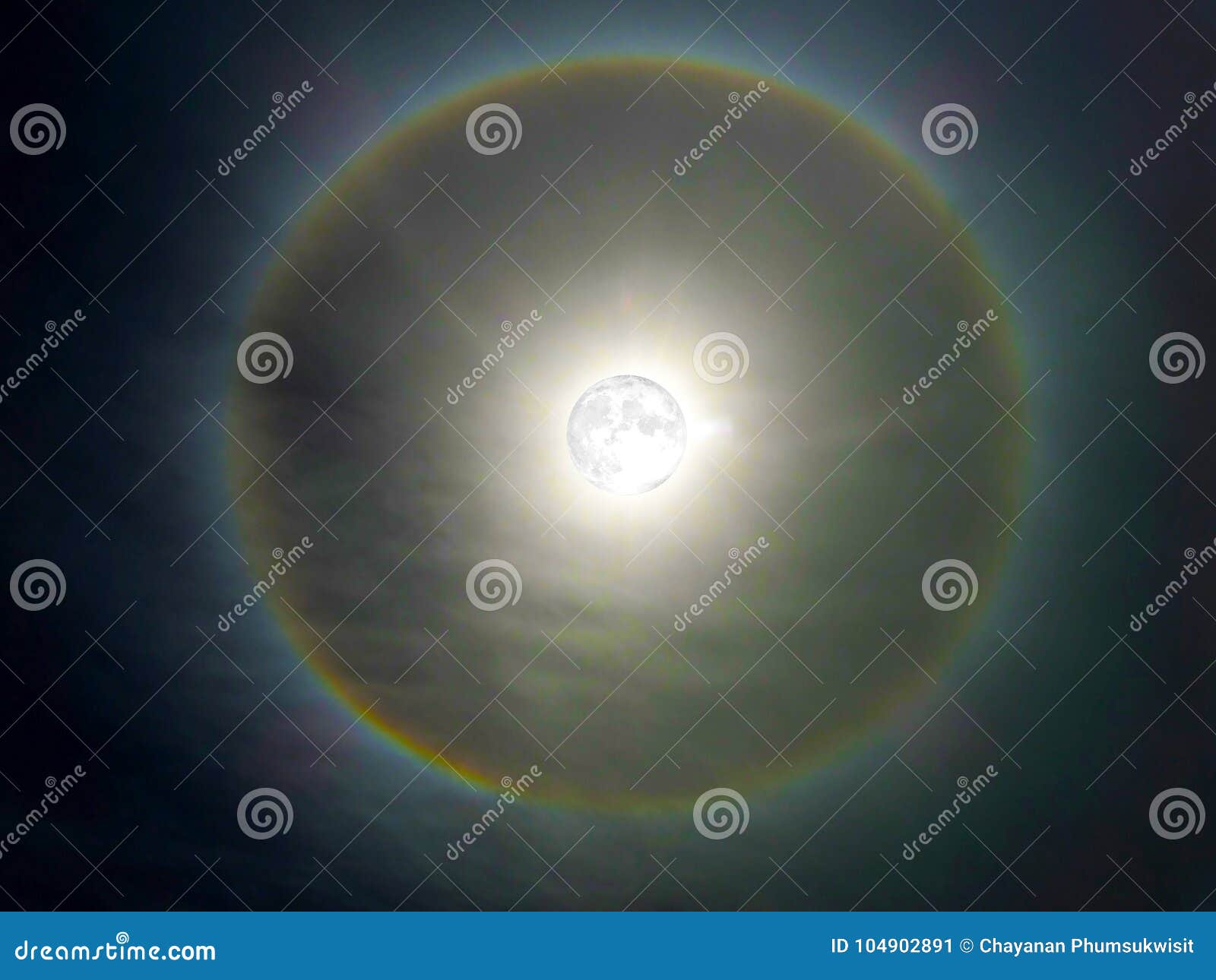
You’re walking outside at night, maybe taking the dog for a quick lap or just grabbing something from the car, and you look up. There it is. A ghostly, shimmering rainbow ring around the moon just hanging there in the dark. It’s a little bit eerie. Honestly, it looks like something straight out of a big-budget sci-fi flick or a medieval omen of impending doom.
In the past, people genuinely thought these rings meant a storm was coming to wreck their crops. They weren't entirely wrong, either. But despite how magical it looks, there isn't any sorcery involved. It’s physics. Pure, cold, atmospheric physics.
Most of us call it a moon ring or a winter halo. Scientists? They call it a 22-degree halo.
The Science of the 22-Degree Halo
So, what’s actually happening up there? It isn't a rainbow in the traditional sense. Standard rainbows happen when sunlight hits liquid raindrops. This moon version is different. It’s caused by ice.
High up in the troposphere—we’re talking five to ten kilometers above your head—the air is freezing. Even in the middle of a sweltering July, it’s sub-zero up there. This is where cirrus clouds live. These aren't your big, puffy "Simpsons" clouds; they are thin, wispy, and made entirely of millions of tiny, hexagonal ice crystals.
When moonlight hits these flat, six-sided ice crystals, it doesn't just bounce off. It enters the crystal, bends, and exits at a specific angle. That angle is almost always 22 degrees.
Why a Ring and Not a Blob?
Because the crystals are oriented randomly in the air, the light gets refracted in a perfect circle around the light source. It's basically a giant game of cosmic pinball where the "flippers" are ice shards.
Wait. Why do some rings look white while others have colors?
If the crystals are shaped just right and the light is strong enough, the light separates into colors just like it does in a prism. Red light bends less than blue light. This creates a faint, reddish tint on the inside of the circle and a soft blue-ish hue on the outside. Most of the time, the moon isn't bright enough for our eyes to pick up the color, so it just looks like a milky white ghost-ring. But on a night with a full moon? You’ll see that rainbow ring around the moon in all its subtle glory.
Forecasting the Weather with the Moon
"Ring around the moon, rain or snow soon."
You've probably heard your grandparents say that. It sounds like a typical "old wives' tale," but it’s one of the few pieces of ancient weather folklore that actually holds water.
Cirrus clouds—those icy ones we talked about—are often the "scouts" for an approaching warm front. These fronts usually bring low-pressure systems and, eventually, rain. When you see that ring, you're essentially looking at moisture moving into the upper atmosphere.
Statistics from the National Oceanic and Atmospheric Administration (NOAA) suggest that if you see a lunar halo, there’s a decent chance of precipitation within 24 to 48 hours. It’s not a guarantee, obviously. Sometimes the clouds just pass through without the storm following close behind. But as a general rule? It’s a solid heads-up to keep your umbrella near the door.
Common Misconceptions and Moon Dogs
People often confuse the 22-degree halo with something called a Lunar Corona. They are not the same thing. Not even close.
A corona is much smaller and sits much tighter to the moon’s surface. While the halo is caused by ice crystals refracting light, the corona is caused by diffraction from tiny liquid water droplets or even pollen in the air. Coronas usually look more like a fuzzy, colorful "aura" than a distinct, sharp-edged ring.
Then there are Moon Dogs, or paraselenae.
If you see bright, glowing spots on either side of the moon—sort of like "mini moons"—those are moon dogs. They happen when the ice crystals are specifically plate-shaped and sinking through the air like falling leaves. This aligns them horizontally, concentrating the light into two distinct points.
The Rarity Factor
Is a rainbow ring around the moon rare? Not really.
In fact, some atmospheric experts argue they are more common than rainbows. The catch is that we just don't look up at night as much as we do during the day. Plus, light pollution in cities can wash out the fainter halos, making them invisible to everyone except those in rural areas with dark skies.
If you’re in a city like New York or London, you might only see the brightest 10% of these events. If you’re out in the desert or up in the mountains? You might see them dozens of times a year.
Tips for Spotting One
You don't need a telescope. You don't even need binoculars. You just need clear eyes and a bit of timing.
- Watch the Moon Phase: Halos are easiest to see when the moon is at least 75% full. The light needs to be intense enough to survive the trip through the ice crystals.
- Look for Thin Clouds: If the sky is perfectly clear, you won't see a thing. You want those "horse tail" clouds that look like thin streaks of white hair.
- Block the Source: Sometimes the moon itself is so bright it blurs your vision. Use your hand to block the actual moon, and the ring will often "pop" into view more clearly.
Why This Matters Today
In an age where we’re all glued to our phones, seeing a rainbow ring around the moon is a pretty grounding experience. It reminds us that the atmosphere is a dynamic, shifting thing. It’s also a great way to introduce kids to science without a textbook. Instead of explaining "refraction" on a whiteboard, you’re pointing at the sky and showing them a 20,000-mile-wide optical illusion.
Expert observers like Les Cowley, who runs the definitive Atmospheric Optics site, have cataloged hundreds of variations of these light phenomena. From "circumzenithal arcs" to "light pillars," the sky is basically a massive laboratory. The lunar halo is just the most common entry point into that world.
Practical Steps for Your Next Sighting
The next time you spot that glowing circle, don't just take a grainy photo and keep walking.
First, check your local weather app. Look at the barometric pressure. If it’s dropping, that ring is a direct confirmation that a weather system is moving in. It’s a fun way to "verify" the digital forecast with your own eyes.
Second, if you're into photography, try to capture it. Using a smartphone? Switch to "Night Mode" and try to keep the phone steady. You’ll want a wide-angle lens because a 22-degree halo is actually huge—it covers a significant portion of the sky. If you’re using a DSLR, go for a wide aperture ($f/2.8$) and a medium ISO to capture the faint colors of the ice refraction.
Lastly, just enjoy it. These rings don't last forever. As the wind moves those high-altitude clouds, the ring might vanish in minutes or shift into a different shape entirely. It’s a temporary masterpiece of physics and light.
What to do now:
- Check a moon phase calendar to see when the next full moon occurs.
- The next time you see "wispy" clouds during the day, keep an eye on the sky after sunset.
- Download a "dark sky" map app to find locations near you with minimal light pollution for better viewing.
- If you see a ring, check the 24-hour forecast immediately to see if the "rain or snow soon" rule holds true for your area.