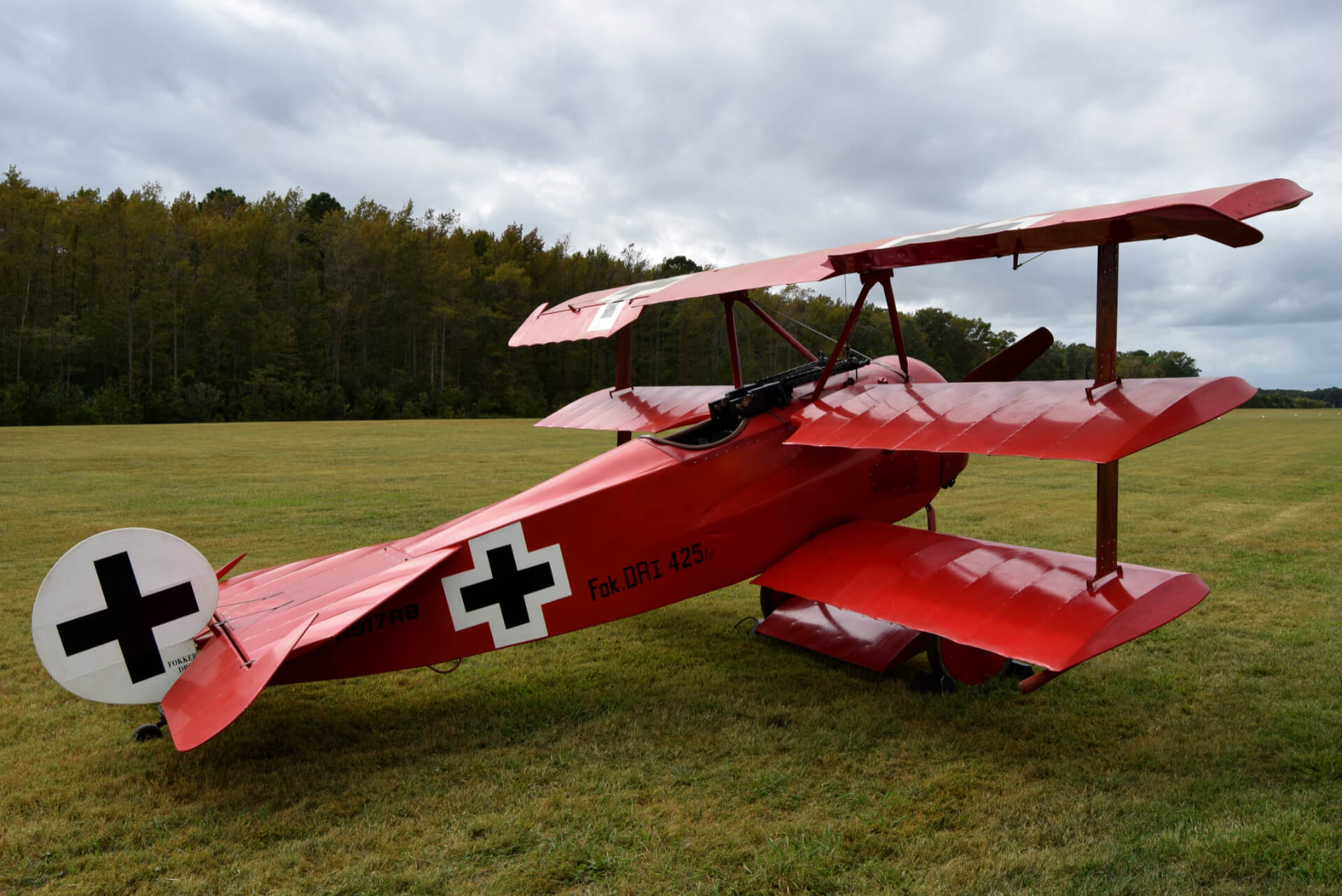
Wooden frames. Stretched canvas. A engine that sprayed castor oil directly into your face for three hours straight. Honestly, it’s a miracle anyone stayed up there for more than five minutes. When people think about world war one airplanes, they usually conjure up these romantic images of knights in the sky, dueling over the French countryside in bright red triplanes. It's a nice thought. It’s also mostly wrong. The reality of early aviation was a desperate, greasy, and terrifying scramble to figure out how to stay in the air without the wings falling off, let alone fighting a war.
The tech moved fast. Really fast. In 1914, pilots were basically flying motorized kites. By 1918, they were piloting all-metal Junkers J.I armored ground-attack planes. That four-year gap represents the most violent, accelerated period of engineering in human history.
The "Fokker Scourge" and why everyone was panicking
Early on, nobody knew how to shoot at each other. Pilots used to wave. Seriously. Then they started throwing bricks, or firing pistols, which—as you can imagine—didn't do much. The real "holy grail" was figuring out how to fire a machine gun through the propeller without blowing your own wooden blades into splinters.
Enter Anthony Fokker. He didn't actually invent the synchronization gear—Franz Schneider patented the idea back in 1913—but Fokker’s team actually made it work on the Fokker Eindecker. This changed everything. Suddenly, a pilot could just point the whole plane at the enemy and pull the trigger. From late 1915 to early 1916, the Germans absolutely dominated the skies. The British called their own planes "Fokker Fodder" because they were so outclassed. It wasn't just a tactical advantage; it was a psychological slaughter.
The myth of the Red Baron
Manfred von Richthofen is the only name most people know. 80 victories. The red Fokker Dr.I triplane. But here's the thing: the triplane was actually kinda slow. It was maneuverable, sure, but by the time it arrived in 1917, it was already getting pushed out by faster, more rugged designs. Richthofen’s success came from his discipline. He wasn't a stunt flyer. He was a hunter who used altitude and the sun to ambush people before they even knew he was there. He followed "Boelcke’s Dicta," a set of rules written by his mentor Oswald Boelcke that basically prioritized survival over "cool" flying.
The engineering was a literal deathtrap
We need to talk about the engines. Most world war one airplanes used rotary engines, like the Gnome or the Le Rhône. In these, the entire engine block spun around a stationary crankshaft. It provided great cooling, but the centrifugal force made the planes want to veer wildly in one direction. Oh, and the lubrication? Castor oil. It didn't burn off; it just sprayed out of the exhaust and into the cockpit. Pilots spent their missions inhaling laxative fumes. You can guess what that did to their stomachs during a dogfight.
The structural integrity was a joke by modern standards. The British S.E.5a was a tank compared to others, but even then, a steep dive could literally peel the fabric off the wings. There were no parachutes for most of the war. The higher-ups actually banned them because they thought it would encourage pilots to abandon their expensive planes too early. It’s one of the most cold-blooded decisions in military history. If your plane caught fire—which happened often because the fuel tanks were right in front of the pilot—you had two choices: stay with the ship or jump from two miles up.
Why the Sopwith Camel was a widow-maker
The Camel is legendary. It shot down more planes than any other Allied scout. But it killed more of its own pilots in training than the Germans ever did. Because the engine, guns, and pilot were all crammed into the front seven feet of the fuselage, the center of gravity was incredibly sensitive. If you knew what you were doing, you could out-turn anything in the sky. If you didn't, the plane would snap-roll and dive into the ground before you could blink. It was a beast that required a master's touch, and in 1917, most "pilots" had about 15 hours of flight time before being sent to the front.
It wasn't just about dogfights
Everyone focuses on the scouts (the fighters), but the real work was done by the observers. The big, slow two-seaters like the R.E.8 or the Albatros C.III were the reason the war lasted so long. They took photos. They spotted for the artillery. Without world war one airplanes acting as the "eyes in the sky," the massive artillery barrages that defined the Western Front wouldn't have been possible.
The bombers were even crazier. The Gotha G.V was a German giant that started hitting London in broad daylight. This wasn't just "front line" stuff anymore; the war was coming to civilians. The British responded with the Handley Page O/400, a plane so big it had to be folded up to fit in hangars. These were the ancestors of the B-17s and Lancasters of the next war.
The transition to metal
By 1918, things were getting weird. Hugo Junkers, a German engineer, realized that wood and fabric had hit a ceiling. He built the Junkers D.I, an all-metal monoplane. It looked like something from the 1930s. It was heavy, but it was almost immune to the small-arms fire that brought down so many canvas planes. If the war had lasted until 1919, the skies would have looked completely different.
Key Technical Specifications of Era-Defining Aircraft
| Aircraft Model | Max Speed | Engine Type | Notable Feature |
|---|---|---|---|
| Fokker E.I | 81 mph | Oberursel U.0 (Rotary) | First effective sync gear |
| Sopwith Camel | 113 mph | Clerget 9B (Rotary) | Extreme maneuverability |
| SPAD S.XIII | 135 mph | Hispano-Suiza (In-line) | Incredible diving speed |
| Fokker D.VII | 118 mph | BMW IIIa (In-line) | Could "hang" on its prop |
The SPAD S.XIII is worth a mention because it moved away from those spinning rotary engines. It used a stationary V8. This allowed for a much sleeker nose and a way more stable platform. It’s why French aces like René Fonck—the highest-scoring Allied pilot—preferred it. It wasn't about the "dance" of the dogfight for Fonck; it was about the math of the kill.
What most people get wrong about WWI air combat
You see it in movies: planes swirling around in a massive "furball." While that happened, it was usually a sign that something had gone wrong. The best pilots—the ones who survived—were the ones who stayed out of furballs. They stayed high. They waited for a straggler or someone who wasn't paying attention.
Also, the "Chivalry" thing? Mostly propaganda. While there were moments of respect, like the Germans dropping a wreath for a fallen British ace, the actual combat was brutal. Pilots would aim for the cockpit to kill the man, not the machine. They’d fire incendiary rounds to light the fuel tanks. It was a high-tech execution.
The psychological toll
The average lifespan of a new pilot in 1917 was measured in weeks. Not months. Weeks. You saw your friends vanish in a puff of smoke or watch them fall out of a burning wing. Because there was no radio, you were completely alone up there. Just the roar of the engine and the smell of oil. It’s no wonder that "flying sickness"—what we now call PTSD—was rampant. They drank. A lot. Most of these "aces" were 19-year-olds who were essentially burning through their life force at ten times the normal rate.
Actionable insights for history buffs and researchers
If you want to actually understand how these machines felt, don't just look at photos. Here is how to get a real sense of the era:
- Visit the Old Rhinebeck Aerodrome: If you're in the US, this place in New York still flies original and authentic reproduction world war one airplanes. Seeing (and smelling) a rotary engine start up is a visceral experience that a museum can't give you.
- Read "Sagitarius Rising" by Cecil Lewis: He was a British ace who survived the war. His descriptions of the sheer beauty and horror of flying these "wire and canvas" machines are unmatched. It’s the gold standard for WWI memoirs.
- Study the "Lufbery Circle": Look up this defensive maneuver named after Raoul Lufbery. It shows the tactical evolution from "individual heroism" to "team-based survival" that happened mid-war.
- Check out the Memorial Flight Association: They do some of the most accurate restorations in the world, particularly with French aircraft like the Salmson 2A2.
The legacy of these planes isn't just in the "aces" or the medals. It's in the fact that in 1914, flight was a circus act, and by 1918, it was an industry. We went from the Wright Brothers to transcontinental-capable designs in less than fifteen years, fueled entirely by the desperate need to win a war. Those wooden cockpits were the brutal nurseries of the modern world.